
Retail Investors Enter Alternative Investments: A Structural Shift and a Systemic Risk
Over the past decade, the alternative investments market has undergone a significant structural shift: once dominated almost exclusively by institutional investors and wealth clients, it is gradually opening up to a broad base of retail investors. Alternative assets account for a growing share of the market – estimates suggest that by 2025 alternative investments will represent roughly a quarter of all invested assets worldwide, compared with only about 12% in 2018. The global investor profile has also changed: the number of individuals with financial assets of more than $1 million tripled between 2000 and 2023, and their aggregate wealth climbed to approximately $214 trillion – nearly half of the world’s wealth. This is an enormous pool of private capital in search of investment outlets, and a growing portion of it is now being channeled into alternative investments. Fund managers, who previously focused on pension funds, institutions and sovereign wealth funds, are increasingly targeting the market of qualified private investors.
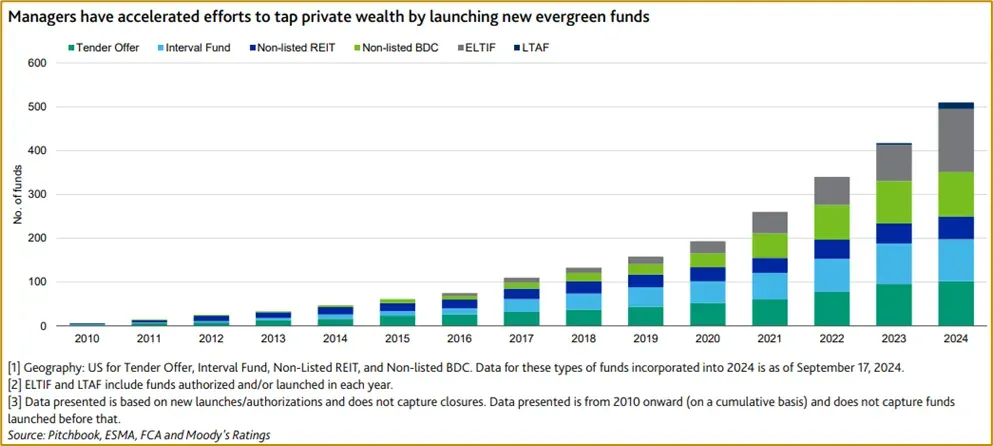
This trend has driven growth in new types of funds tailored to individuals. Evergreen funds (with an unlimited life) and other open-ended funds that allow periodic subscriptions and redemptions are gaining popularity. In fact, open-ended alternative funds – such as perpetual private equity funds, open-ended private credit funds, non-traded real estate funds, Business Development Companies (BDCs) and interval funds – have proliferated rapidly in recent years. Their number worldwide reached 531 open-ended funds in 2024 – an increase of 8.4% from 490 funds in 2023. Although their size is still modest relative to the overall private market (approximately 5% of alternative assets, or about $700 billion), forecasts project that within roughly a decade they will account for up to 20% of the market – a significant share that reflects the growth of private investment. The structural shift is thus reflected in the transformation of alternative investments from a closed club of institutional players into a broader investment arena with growing participation of private capital. This trend brings new opportunities, but it also demands careful scrutiny of the attendant risks – up to and including systemic risk to the market as a whole.
The retail expansion into the alternatives market is being enabled by significant legislative and regulatory changes across Western countries. In the United States, the eligibility thresholds for “accredited investors” remain high, but there is a trend toward some easing: over the past decade the federal regulator (the SEC) has reviewed updates to the accredited investor definition, and the private investment industry is lobbying to widen the circle of eligible investors. In one industry survey, approximately 75% of US industry professionals said the current “accredited investor” definition is too rigid and should be relaxed. In practice, the US industry has adopted innovative solutions within the existing legal framework: the growth of semi-liquid, closed-end registered funds such as interval funds or tender offer funds (offered on a continuous basis under the US Investment Company Act) allows non-institutional investors to participate in illiquid investments as well, subject to meeting accredited investor criteria. These funds offer relatively low investment minimums, more transparent reporting, and sometimes convenient tax reporting (Form 1099 in the US) – and in return they restrict liquidity (for example, a single redemption window per quarter or caps on the maximum percentage that can be redeemed). At the same time, US policymakers are signaling growing openness: for example, permission to include limited private investment components within certain retirement and provident plans. There is an expectation that, given a suitable political climate, the SEC will advance further relief allowing capital to be raised from the general public for alternative products, while maintaining investor protections.
Europe has adopted a proactive approach to opening the alternative investments market to a wider audience. As early as 2015, the ELTIF framework was introduced with the aim of allowing retail investors to invest in long-term closed-end funds, subject to strict limitations. However, the first version of the ELTIF proved cumbersome and off-putting for managers and investors alike – the number of funds launched under it was limited (only 93 funds over the 2015–2023 period). In response, the European Union approved a sweeping reform known as ELTIF 2.0, which took effect in 2024. The updated regulation significantly eases the requirements on these funds: it removes key barriers to entry (eliminating the €10,000 minimum investment requirement for retail investors) and broadens both the range of eligible alternative assets and the liquidity management options. In effect, ELTIF 2.0 is designed to make private investments in Europe more accessible, in recognition of the fact that there is a broad investor population interested in non-traded assets. As early as the beginning of 2024, there was a noticeable increase in registrations of new ELTIFs across the EU. Luxembourg, as a fund hub, leads in the number of launches (approximately 65% of ELTIFs are registered there), but countries such as Italy, France, Spain and Germany are also joining the trend. The updated ELTIF framework now allows easier distribution of these funds to retail investors across Europe, subject to transparency obligations, risk warnings and liquidity management tools such as lock-up periods and redemption limits, which are designed to protect both investors and the fund.
In the United Kingdom, the move to open alternative investments to the public took the form of the LTAF (Long-Term Asset Fund) structure. The LTAF is an open-ended fund dedicated to illiquid assets, launched by the UK regulator (the FCA) in October 2021 with the aim of encouraging long-term private investment backed by capital from retail investors as well. Under the rules, an LTAF must invest at least 50% of its assets in non-traded assets (infrastructure, real estate, private credit, venture capital, etc.) and may use leverage up to a cap of 30%. Initially, LTAF distribution was restricted to sophisticated investors only, but in July 2023 the FCA adopted relief extending it to a “mainstream” audience under new definitions. The LTAF was reclassified as a Restricted Mass Market Investment instead of a product not suitable for the mass market, which allowed it to be marketed to the general public but requires adequate disclosure and prominent risk warnings. Among other things, requirements were introduced that marketing an LTAF to the public must be accompanied by warnings about liquidity risk, minimum redemption notice periods (at least 90 days) and a redemption frequency no greater than once a month. In addition, protections were added such as the right to convene meetings of unitholders in the event of a material change, regular investor updates, and limits on performance fees and on the level of distributor commissions. These measures reflect the approach of regulators in the UK and Europe: to encourage public participation in private capital markets, while building “guardrails” to prevent harm to ordinary investors and to financial stability.
Risks and Challenges of Retail Investor Participation:
Alongside the opportunity of opening private investments to the broader public, significant challenges and new risks are emerging. Understanding these risks is essential to ensure that democratization does not become a double-edged sword. Below are some of the key risks:
Knowledge Gap: Many retail investors lack the knowledge and experience needed to evaluate private equity deals, hedge funds or structured credit. Unlike large institutions with teams of analysts, it is harder for an individual investor to conduct in-depth due diligence or to understand the complex legal and financial structures of alternative funds. In a survey of advisors and investment managers, nearly 69% cited a lack of understanding and financial education in alternatives as a major barrier to investor participation. The implication of the knowledge gap is not only that investors may make poor decisions, but also that they may be more vulnerable to aggressive marketing or false promises. For example, a large private real estate fund marketed itself in general terms as a liquid fund, yet many investors were surprised to discover withdrawal restrictions in certain months – suggesting that they had not read or had not understood the fund’s terms. The knowledge gap calls for stepped-up education and disclosure efforts, by fund managers as well as by advisors and regulators.
Liquidity Risk and Redemption Restrictions: Many alternative assets – whether private companies, infrastructure projects or non-traded loans – are inherently illiquid. Placing such assets inside products open to retail investors requires a compromise: the possibility of periodic redemption (usually monthly or quarterly), but subject to strict limitations. Investors may find that during a market panic, when they want to get their money out, the exit door is very narrow. Moreover, a prudent investor should assume that any evergreen fund will, for some period in the future, impose withdrawal restrictions – a period during which that investor, too, may wish to redeem. In other words, investors in these funds should treat the investment as a long-term, low-liquidity commitment. Liquidity risk is not limited to the individual investor who cannot get their money back immediately – it carries the potential for systemic liquidity stress: if many investors in the same asset class seek to exit at the same time, many funds will activate exit gates or deferrals, which could undermine public confidence in the industry and amplify panic.
Pricing and Valuation: One of the advantages of private investments is low volatility, which stems from the fact that investment values are largely determined by valuations performed by the fund or a party on its behalf, as opposed to public markets, where value is determined by the prices of executed trades. However, the absence of ongoing pricing can also mask accumulating risks. When funds are required to update asset values in light of adverse events (such as a borrower default in a private credit fund or a markdown of a startup in a venture capital fund), a “drop” in asset values may occur – an unpleasant surprise for investors. In other words, volatility may be low, but ultimately the economic value of the fund’s assets will be revealed. In addition, there is a risk of overvaluation – fund managers may, in a biased manner, maintain high asset values during difficult periods in the absence of a traded market, which can give investors a false sense of security until the assets are realized.
A Risk Profile Not Suited to Every Private Investor: Not every retail investor – and not even every accredited investor (as legally defined) – is inherently suited to alternative investments. There is considerable variation in risk-bearing capacity, liquidity needs and investment horizon between households and institutions. There is a concern that private investors will take on risks they do not fully understand, or that alternative investments will make up too large a share of their portfolio without sufficient diversification. For example, investing in a leveraged private credit fund is fundamentally different from investing in a rated bond fund – the risk of capital loss is much higher, but to an unsophisticated investor the distinction is not always clear. The lure of “stable” double-digit returns may draw households into investing at a high level of risk – beyond what is appropriate for them.
Potential Systemic Risk and Regulatory Implications:
The massive influx of retail investors into the alternatives market raises a critical question: is the financial system as a whole becoming more vulnerable to shocks? Risk management experts and regulators are beginning to consider the possibility of systemic risk arising from the democratization of alternative investments.
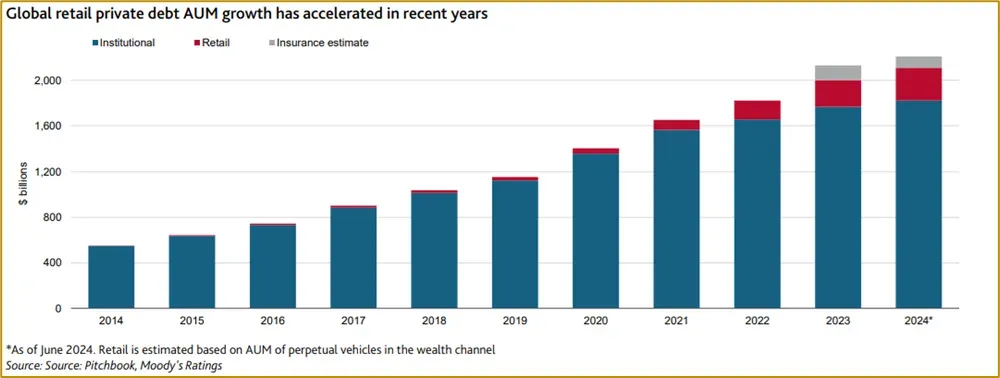
The starting point is that the private investment market has become large and significant in scale. As described, hundreds of billions of dollars are flowing from retail funds into private companies, leveraged real estate and non-traded loans. The private credit sector, for example, has grown to approximately $1 trillion in North America, approaching the size of the syndicated bank loan market ($1.4 trillion). This growth has been driven in part by private investors in alternative funds, who stepped into the void left by the banks – which has benefited the economy, but has also created a new web of risks. The rating agency Moody’s has warned that given the size and opacity of the private credit market, a deterioration in credit quality could spread quickly and lead to broad disruptions across financial markets and the wider economy. Their warning carries even more weight when the retail component is added to the equation: according to Moody’s, an aggressive push to bring retail investors into private markets late in the credit cycle, particularly in a period of inflation and rising interest rates, could increase the transmission of risk from the private sector to the financial system as a whole. In effect, more “sensitive” and leverage-heavy capital could accelerate a chain reaction – from the collapse of borrower companies, through losses at credit funds, to a loss of investor confidence in other sectors.
Another potential channel of systemic risk relates to the liquidity pressures described earlier. Imagine a scenario in which a popular private market (for example, commercial real estate) suffers a sudden shock: many retail investors, who are not accustomed to negative revaluations and lack the patience to wait for a prolonged recovery, may try to withdraw their money at the same time. Even with gating mechanisms in place, the very announcement of suspended redemptions at several large funds could trigger a snowball of concern, and lead investors to sell at a loss in any other liquid asset class in order to raise cash. The Bank of England has previously warned that mass withdrawals from illiquid funds can exacerbate market downturns through increased selling pressure on liquid assets (as managers are forced to sell liquid holdings to provide partial liquidity) and by undermining overall investor confidence in the system.
We should emphasize that the economy’s major capital providers – such as banks, insurance companies and pension funds – are also increasingly invested in alternative funds in pursuit of yield. In a private market crisis, they could suffer substantial losses on their alternative portfolios, which could lead them to curtail lending elsewhere (to maintain capital adequacy ratios, for example), thereby deepening a recession. Since the boundaries between “institutional capital” and “retail capital” are blurring (many funds today combine both types of capital), the systemic risk is not theoretical. As the Moody’s report notes, retail investors already provide a growing share of capital to private credit funds – which supports the market’s growth but at the same time adds a new layer of risk.
Summary:
The entry of retail investors into alternative investments at growing scale is no longer a marginal phenomenon – it represents a paradigm shift in the private market. This shift holds the promise of growth, broader wealth distribution and new opportunities to raise capital for economic projects. But at the same time, it creates an urgent need for responsible conduct on the part of all participants: investors, fund managers and regulators. We must remember that the private market grew and developed organically in the hands of professionals, and now that it is expanding to the masses, we have an obligation to ensure that the process is carried out prudently.
Ultimately, the alternative investments market can become an even more stable and significant pillar of the global financial system – provided that its expansion to the public is accompanied by responsibility, discipline and long-term thinking. The goal is responsible democratization: combining the benefits of broad access to private capital without compromising on risk management or on the interests of investors at every level. If we succeed in this task, we will all benefit from a thriving, diverse and safer alternatives market that serves both new retail investors and established institutions – while preserving the stability of the system as a whole.
Disclaimer:
Nothing in this publication constitutes an offer to the public or an invitation to make any investment; it is a publication and presentation of general information only. This article and its contents rely on information, publications and data received from third parties, which have been assumed to be accurate without the Company having reviewed or verified their accuracy. The information presented in this publication does not constitute investment advice/marketing or a substitute for investment advice/marketing tailored personally and specifically to each individual, taking into account their particulars, needs, financial situation, circumstances and investment objectives.
Sources:
Moody’s Investors Service. (2025, May 7). Private Credit – Global: Asset managers race to innovate retail funds amid liquidity risks. Moody’s Financial Institutions Sector-In-Depth Report.