
A Look at the Sharp Price Declines in Listed BDCs
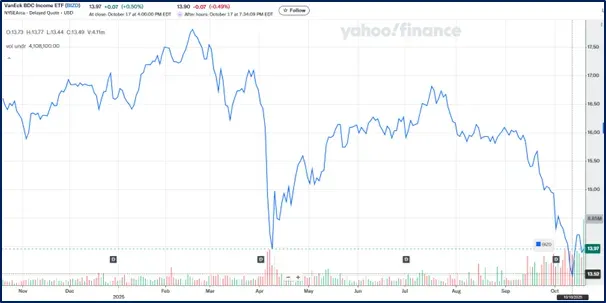
Listed BDCs, which operate in the US direct lending market, posted sharp and almost across-the-board declines over the past month. The ETF that tracks these funds (BIZD) fell a cumulative ~16% from the beginning of September to October 10 (see chart). This time, the decline was not accompanied by parallel declines in the equity market, unlike what happened in April, when investors were worried about the impact of the tariffs the US had imposed at the time. So what is happening now in the listed BDC market?
BIZD price and trading volume over the past year
(ETF on listed BDCs, source: Yahoo Finance)
To understand what is driving the declines, one needs to know the main characteristics of BDCs. These funds hold portfolios of direct lending loans (US corporate debt, extended mostly to companies acquired by private equity funds). Most of the loans are floating-rate, based on SOFR, with an average term of 5-7 years. The average spread on these loans is relatively high (historically in the 5-8% range, on top of the base rate), depending on credit risk and the characteristics of the loan and the borrower.
BDCs distribute most of their interest income as dividends (in return for tax benefits, similar to REITs), and as a result they pay high dividend yields, between 8% and 12% for most funds. The high dividend yield attracts investors who are willing to take on the credit risk inherent in direct lending. This credit risk is magnified by the funds’ leverage; most listed funds currently run leverage of 50% to 55% in debt-to-total-assets terms (and it can reach as high as 67%).
Because the loans are floating-rate, rate cuts by the US Federal Reserve directly reduce the potential interest income from the funds’ loan portfolios. Moreover, over the past two years, spreads on newly underwritten direct lending loans have compressed sharply, from around 650 bps to around 500 bps (i.e., from a spread of about 6.5% over SOFR on loans originated two years ago to about 5% over SOFR on loans originated during 2025), due to a massive influx of investors into the asset class and intensifying competition for deals. This compression also reduces potential interest income.
These 2 effects (the decline in the base rate and spread compression) are now leading most funds to cut their dividends, in light of the decline in the interest income they receive from their loan portfolios. The lower dividend makes holding a BDC less attractive, a consideration that carries particular weight for yield-focused investors.
In addition, in recent weeks concerns have emerged about the quality of the credit held in the funds’ portfolios. These concerns stem from several factors:
-
The massive inflow of investor capital into the sector in recent years has, as noted, led to heightened competition for deals and tighter spreads, so it is also very reasonable to assume that underwriting quality has deteriorated over time. Support for this assessment can be found in the gradual increase over the past decade in PIK as a share of total interest income.
-
Two highly indebted US companies have filed for bankruptcy in recent weeks: First Brand (auto parts) and Tricolor (auto loans to borrowers with low credit ratings). Most BDCs had no direct exposure to these two companies, since those companies had borrowed mostly from the banking system. Nevertheless, these events raised questions about underwriting quality in the market, and prompted an exchange between senior US banking executives and BDC managers on the issue.
-
On October 2, Barron’s published an article warning against investing in BDCs, and similar articles appeared in other media outlets at the same time. These articles brought questions about the funds’ underwriting quality to the forefront of investors’ minds (interestingly, on October 10 Barron’s published an article in the opposite spirit, suggesting that at current pricing, investing in BDCs may in fact be attractive).
The declines in listed BDC prices stem both from (justified) expectations of lower dividend yields as a result of falling US interest rates and spread compression on new underwriting, and from growing questions about credit quality (yet to be seen). On the positive side, the magnitude of the declines is relatively large and, for some funds, reflects a high rate of expected defaults (the funds currently trade at an average discount of about 20% to NAV, with very wide dispersion among them, according to investors’ assessment of each fund’s portfolio quality and leverage). In addition, historical data for the direct lending market show relatively low default rates over time. We would also note that non-traded BDCs, which are valued by the funds themselves (or by a third party on their behalf), have not shown a decline in value, so a pricing “gap” has opened up between these two groups.
Without making investment recommendations in this review, we will limit ourselves to the assessment that we are at a turning point in the BDC market. After years of massive investor inflows into the sector, the funds’ return potential is being adjusted downward in line with current conditions, and investors’ attitude toward the risk of investing has shifted. As a result, the pace of inflows into listed BDCs is expected to moderate (as happened over the past two years in the non-traded BDC market), stop, or even turn into net investor outflows. At this point in time, investment decisions become more important, both with respect to the appropriate level of exposure to the sector and with respect to fund selection.
Disclaimer: Nothing in this publication constitutes an offer to the public or an invitation to invest of any kind; it is a publication and presentation of general information only. The article and its content rely on public information, as well as publications and data received from third parties, which were assumed to be accurate without the company having examined or verified their accuracy. The information presented in this publication does not constitute investment advice/marketing or a substitute for investment advice/marketing tailored personally and specifically to each individual, taking into account their data, needs, financial position, circumstances and investment objectives.**