
Rising Default and Delinquency Rates in the U.S. CMBS Market
The U.S. CMBS (commercial mortgage-backed securities) market is experiencing a sustained increase in risk levels. Delinquency and default rates on loans backed by commercial real estate have been trending upward for some time, with the office and multifamily sectors at the center of the storm. According to Trepp data, in just six months the overall U.S. CMBS delinquency rate rose from 6.30% to 7.29%, and has risen cumulatively by approximately 185 basis points compared with the previous year – a figure that points to a significant deterioration in credit risk. In this article, we review the latest data and the key trends by sector, and discuss the risks and possible implications for the capital markets and institutional investors. The article is based on data from the following companies: Trepp, Fitch Ratings and Credaily.
Recent macro data:
According to Trepp’s August 2025 report, the overall default and delinquency rate increased for the sixth consecutive month. The rate climbed to approximately 7.29% of the total outstanding loan balance; by comparison, a year earlier it stood at just 5.44%. The continued increase indicates that credit distress in the commercial real estate sectors continues to deepen. In dollar terms, total delinquent debt reached $44.1 billion in August out of approximately $604.6 billion in outstanding loans, up from $43.3 billion in July. During August, a further approximately $4.8 billion of loans became delinquent, while at the same time only about $3.8 billion cured (returned to regular payment). This gap results in a net increase in the volume of distressed debt.
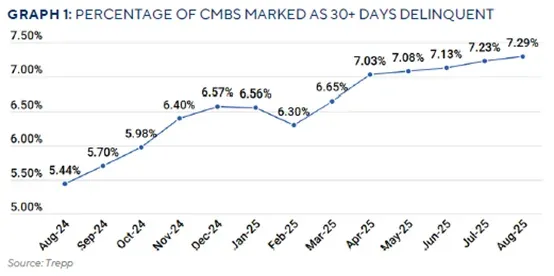
Within this overall rate, the share of loans in the seriously delinquent category (60+ days, in foreclosure, REO, or non-performing at maturity) rose slightly to approximately 6.88% of total loans. At the same time, the early-stage delinquency component (30 days delinquent) rose to 0.41%, indicating a growing “pipeline” of loans that could deteriorate into serious delinquency. It should be noted that if the category also included loans that are past their maturity date with principal unpaid but that are still making interest payments, the overall delinquency rate would reach approximately 9.3% – a measure that illustrates the extent of potential insolvency in the system beyond what is reflected in the headline index.
Data from the rating agency Fitch Ratings also support this picture. The data highlight the role of the office and multifamily sectors in the deterioration of credit quality. A report published by Fitch in early August 2025 stated that the delinquency rate (as defined by Fitch, which focuses on loans more than 60 days delinquent within CMBS transactions it rates) rose by 6 basis points in July, to approximately 3.16%. Fitch attributes this increase mainly to defaults on large loans in the office and rental apartment sectors, which “pushed” the overall delinquency rate higher. In fact, Fitch’s report emphasizes that office loans and residential loans led the increase in distressed debt in the system, directly in line with the trends identified by Trepp. For example, it noted that a number of large loans on multifamily properties (such as complexes in New Jersey and Manhattan) defaulted during the month, each in amounts of tens of millions of dollars – illustrating the severity of the distress in the sector.
\
At the same time, Fitch reported that the share of CMBS loans in special servicing – an indicator of the volume of loans that have entered renegotiation or workout – continued to rise. As of the end of June, this rate reached approximately 5.7% of all loans (and approximately 14.2% in the office sector), compared with 5.6% in May, and July and August data are expected to reflect a further increase, due to the rise in defaults during those months. This figure illustrates the burden of handling problem cases and the growing risk to holders of the relevant securities, particularly those with heavy exposure to office and apartments.
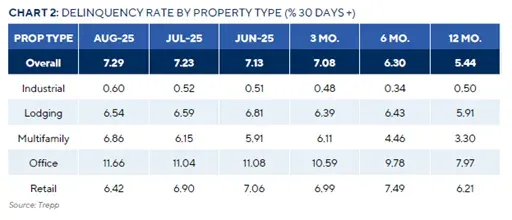
An article published on the Credaily website in late August 2025 sheds light on these trends and provides broader market context. According to Credaily, August marked new highs in the office and multifamily sectors, pointing to “deeper market stress” in these sectors. The office delinquency rate reached an all-time high of 11.66% (a monthly increase of 0.62%), and multifamily climbed to approximately 6.86% – the highest level in the sector in nine years. Credaily explains that the macro trends reflect distress on the ground: in office properties, the combination of low occupancy, the shift to hybrid/remote work and weakened demand has led to a sustained deterioration in cash flows. In multifamily, an oversupply of housing units combined with eroding purchasing power (as a result of inflation and interest rate increases) is undermining property owners’ ability to raise rents and maintain a healthy debt service coverage ratio. These factors are reflected in rising delinquencies precisely in a sector that was previously considered relatively resilient, and illustrate the depth of the current challenges.
Moreover, the Credaily report also points to further deterioration in August. In that month, approximately $2.5 billion of office loans became delinquent, while only about $1.3 billion returned to performing status (through payoff or debt restructuring). By contrast, the picture in the retail sector is more positive: in August, the sector recorded new delinquencies of approximately $300 million against approximately $700 million of loans that cured – resulting in a net decline in the retail delinquency rate to approximately 6.42%, the lowest level in the retail sector over the past year. This shows that the distress is not uniform across all sectors – while office and residential are under increasing distress, retail and even hospitality are showing a certain degree of relative stability.
Credaily analysts conclude that the overall picture is that the CMBS market is under pressure, with variation across sectors: office is facing “long-term challenges due to changing work habits,” multifamily is dealing with “high construction supply and tight household budgets” – while retail “continues to recover, showing that not all property types are being hit equally.”
Sector comparison:
Based on Trepp’s August 2025 data, the following are the delinquency rates (30+ days) in the five main sectors and their trend changes:
- Office 11.66% - delinquency (a new record, up 62 basis points from July). This is the weakest sector, having jumped from approximately 7.97% a year earlier due to tenant departures and declining demand.
- Multifamily – 6.86% delinquency (a monthly increase of 71 bps, the highest level since 2016). By comparison, a year earlier the delinquency rate stood at just approximately 3.30% – nearly doubling year over year, reflecting the pressure in the rental apartment sector.
- Lodging 6.54% - delinquency (a slight decline of 5 bps this month). The lodging sector is showing volatility: despite a slight improvement in August, the level is similar to that of last year (approximately 5.91% in Aug. 2024), owing to a slow but ongoing recovery in tourism and business travel.
- Retail – 6.42% delinquency (a decline of 48 bps this month, to a one-year low). This is a marked improvement compared with ~6.90% in July and versus 6.21% a year earlier, thanks to a recovery in shopping centers and the resolution of delinquent debt through refinancing and asset sales.
- Industrial – 0.60% delinquency (a negligible increase of 8 bps this month). This rate remains the lowest of all sectors, with no material change from last year (0.50%), indicating the continued strength of logistics and industrial properties even in the midst of a challenging economic cycle.
The office sector clearly stands out negatively in its overall default and delinquency rate, while in the industrial sector the rate is the lowest. Multifamily, despite having enjoyed stable performance in the past, is experiencing a sharp increase in risk, while retail and lodging sit in between – in a relatively more stable position, and even showing a moderate improving trend recently.
Summary and outlook:
The consecutive rise in delinquency and default rates in the U.S. CMBS market is a warning sign for the financial system and for sophisticated investors. Data from this past summer paint a clear picture: heavy pressure in the office and multifamily housing sectors, versus early signs of stability or improvement in other sectors. These trends are fueled by structural changes (such as the shift to working from home, which is hurting office demand) and by macroeconomic factors (high interest rates, inflation and financing pressures in the housing sector). In the near term, distress in the CMBS market is expected to remain elevated. As Credaily notes, as long as many loans reach maturity without a refinancing solution, and the cash flows of many properties remain strained, it is hard to expect the wave of delinquencies to ease. Some sectors may find a degree of equilibrium (for example, retail and industrial are showing relative resilience), but on the other hand, the key sectors noted above will continue to weigh on the capital markets. Looking ahead, the market will be watching leading indicators (such as the share of loans 30+ days delinquent) to identify signs of a turnaround, but for now – the distress in the U.S. CMBS market poses significant and ongoing challenges, particularly with respect to office and multifamily.
Disclaimer:
Nothing in this publication constitutes an offer to the public or an invitation to make any investment; it is a publication and presentation of general information only. The article and its contents rely on information, publications and data received from third parties, which were assumed to be accurate without the Company having reviewed or verified their accuracy. The information presented in this publication does not constitute investment advice/marketing or a substitute for investment advice/marketing tailored personally and specifically to each individual, taking into account their particulars, needs, financial situation, circumstances and investment objectives.
Sources:
Fitch Ratings. (2025, August 8). Multifamily and Office Defaults Propel U.S. CMBS Delinquency Rate Higher in July. Fitch Ratings. Retrieved from https://www.fitchratings.com/research/structured-finance/multifamily-office-defaults-propel-us-cmbs-delinquency-rate-higher-in-july-08-08-2025.
CRE Daily. (2025, August 29). CMBS Delinquency Climbs Amid Office and Multifamily Woes. CRE Daily. Retrieved from https://www.credaily.com/briefs/cmbs-delinquency-climbs-amid-office-and-multifamily-woes.
Trepp. (2025, August 28). CMBS Delinquency Rate Increases Again in August 2025. TreppTalk. Retrieved from https://www.trepp.com/trepptalk/cmbs-delinquency-rate-increases-again-in-august-2025.