
How Employee Motivation Affects Share Price

A J.P. Morgan research report, What Drives Employees: Intrinsic or Extrinsic Factors, examines what motivates employees – intrinsic motivations (such as a sense of meaning, identification and recognition) versus extrinsic motivations (such as pay and financial rewards). Its findings indicate that an organization’s ability to cultivate high-quality human capital and a positive corporate culture is not merely a management or organizational issue, but a key factor with a direct impact on companies’ business and financial performance as well. The Human Capital Factor study found that, over the long term, such companies generated excess returns of approximately 4% per year relative to market indices.
Background and key findings: intrinsic vs. extrinsic motivation:
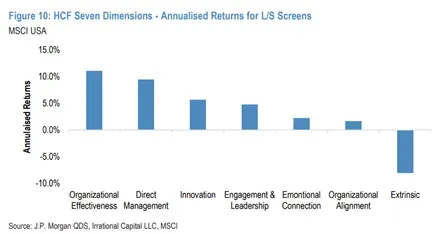
The report defines seven main dimensions that make up the “Human Capital Factor” – six of them related to intrinsic motivation and only one to extrinsic factors. Intrinsic motivations include, among others, quality of management (trust and respect between managers and employees, support for personal development), emotional connection to work (a sense of meaning, recognition and psychological safety), the employee’s level of engagement and pride in the organization, a culture that encourages innovation and creative thinking, alignment between the employee’s values and the company’s values, and organizational effectiveness reflected in internal collaboration and a positive atmosphere. Extrinsic factors, by contrast, essentially come down to the formal “basics”: pay, benefits and tangible working conditions (such as the physical environment and training programs).
The report’s central finding is that employees are driven by a combination of all these factors – but intrinsic factors play a decisive role in generating high motivation and contributing to productivity. In other words, money and good conditions matter as a foundation, but on their own they are not the strongest drivers of peak performance. An organization’s ability to capture and nurture both intrinsic and extrinsic motivational criteria is key to optimally motivating employees – something that not only contributes to employee well-being, but is also directly linked to better business outcomes, all the way down to share-price returns.
Impact on the labor market: retention, engagement and productivity:
Recent labor-market trends reinforce the report’s conclusions. In an era of a “war for talent” and competition for skilled workers, many employees rank corporate culture, professional development and meaning at work as no less important (and sometimes more important) than salary level. The wave of resignations that hit organizations after the COVID-19 crisis demonstrated that employees who do not find fulfillment, recognition and a sense of belonging will be willing to leave, even if the pay at their next job is similar or only slightly higher. An employee with high intrinsic engagement – who feels connected to the organization’s goals and valued by it – will tend to stay for the long term and go beyond what is required. Conversely, when motivation rests mainly on extrinsic rewards, commitment to the organization is looser and the employee may move to a competitor for a marginal financial benefit. Quantitative research supports this: companies with highly engaged employees show higher productivity and profitability, and significantly lower employee turnover. According to Gallup data, organizations in the top quartile of employee engagement enjoy, on average, 18% higher productivity and 23% higher profitability compared with low-engagement companies . In addition, their attrition rate is about 20% lower than that of competitors (particularly in high-turnover industries).
Economic implications and impact on companies and business models:
Whereas company valuations once relied mainly on tangible assets and “hard” financial data, today human capital and corporate culture are recognized as key value drivers – albeit often intangible ones. In practice, a huge share of the market value of large companies consists of intangible assets such as goodwill, know-how, software and human capital, rather than physical property on the balance sheet. Yet this critical human asset is barely reflected in traditional financial statements. Because human capital does not appear on the balance sheet, an informational inefficiency arises in the market – and with it an opportunity for companies (and their investors) to unlock hidden value. As the report notes, precisely because human capital is not formally reported, it is possible to achieve excess returns by identifying the companies with superior human capital.
From a management standpoint, this means companies must design business models and corporate cultures that place employees and their needs at the center. Over time, an organization that fosters intrinsic motivation among its employees can expect increased innovation, continuous improvement in products and processes, and an enhanced market image – fueling business growth and business-model sustainability. At the same time, companies that rely mainly on extrinsic incentives may face growing business challenges, such as difficulty attracting and retaining talent, reduced creativity, and a negative image that may also affect customer loyalty.
Implications for investment decisions:
For investors, too, understanding the drivers of employee motivation can become a valuable tool in investment decision-making. First, institutional and private investors alike can incorporate qualitative human capital metrics into their analysis: for example, examining employee satisfaction, the company’s employee turnover rates, the level of investment in professional development, and diversity and equal opportunity – as a proxy for motivation and the strength of corporate culture. Investors focused on ESG (environmental, social and governance) have already begun to include human capital metrics within the social “S” component – recognizing that a company’s treatment of its employees is a material indicator of risk and responsible management. For example, a company with low employee engagement may face reputational risk or business disruptions (such as strikes or mass departures), whereas a company that succeeds in nurturing its employees mitigates these risks.
The J.P. Morgan study also demonstrates a strategic opportunity within the investment arena itself. Investors who implemented stock-selection strategies based on the quality of companies’ human capital – that is, favoring companies with high intrinsic motivation and corporate culture scores – generated excess alpha. According to the report, a portfolio of companies with a high “Human Capital Factor” delivered, over the long term, returns approximately 4% per year above the benchmarks. Such findings have led to the development of dedicated indices and ETFs focused on companies with strong human capital (for example, Human Capital Factor indices and the ETFs that track them), evidence that the market has begun to price in the human capital advantage. For the professional investor, a deep understanding of intangibles – and above all, human capital – can become a competitive advantage in capital allocation.
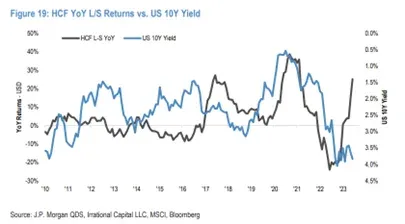
The bottom line: In a world where “motivated” employees are a prerequisite for business success, investors need to look beyond the financial statements and ask how a company manages its most important asset – its people. According to the study, those who correctly identify the companies that motivate their employees through a balanced combination of extrinsic rewards and intrinsic meaning stand to reap the rewards of their investment over the long term – both in company performance and in portfolio returns.
Disclaimer:
Nothing in this publication constitutes an offer to the public or an invitation to invest of any kind; it is a publication and presentation of general information only. This article and its contents rely on information and published data received from third parties, which were assumed to be accurate without the company having examined or verified their accuracy. The information presented in this publication does not constitute investment advice/investment marketing, nor is it a substitute for investment advice/investment marketing tailored personally and specifically to each person, taking into account their data, needs, financial situation, circumstances and investment objectives.
Sources:
J.P. Morgan. (2023, August 17). ESG - Human Capital Factor: What drives employees, intrinsic or extrinsic factors? J.P. Morgan Global Quantitative & Derivatives Strategy.