
Global Wealth at a Peak: Insights from the UBS 2025 Report and the Implications for Israel
The UBS Global Wealth Report 2025 presents an updated picture of the distribution of personal wealth worldwide, for the 16th consecutive year. This year’s report is unusual in its focus on several new and prominent themes: the rise of the “Everyday Millionaire” (see below) – an investor segment that has been neglected in the past – and an in-depth analysis of generational trends and intergenerational wealth transfer. In addition, after a period of economic turbulence, the report emphasizes that global wealth has returned to growth at an accelerating pace, but unevenly across geographic regions. These insights, together with key regional data, provide a compass for investors and institutions as they navigate global markets.
2024 was marked by an impressive recovery in global wealth. Global private wealth grew by approximately 4.6% over the year – higher than the increase in 2023 (4.2%). Most of the growth was led by North American markets: the region enjoyed a sharp jump thanks to robust financial markets and a stable US dollar. In fact, the Americas (North and South combined), where wealth grew by more than 11%, contributed the lion’s share of global growth. In contrast, growth elsewhere was more modest: Asia-Pacific recorded an increase of less than 3%, and Europe, the Middle East and Africa combined – less than 0.5%. In other words, wealth creation was not uniform across the world; the boom in US capital markets lifted wealth in North America, while other regions stagnated.
The result is that adults in North America are now the wealthiest in the world in terms of average wealth – approximately $593 thousand per person, compared with approximately $497 thousand in Oceania and approximately $288 thousand in Western Europe. At the same time, more than half of the countries examined actually experienced a decline in average wealth per adult over the past year, in real terms. This shows that in many countries wealth was eroded by inflation, currency fluctuations or weak local markets – a phenomenon that global investors must take into account.
One of the interesting findings in the report is the surge in the number of EMILLIs (Everyday MILLIonaires) – a term for “everyday” millionaires with liquid wealth of $1–5 million. It turns out that this investor segment, which is often not in the industry’s focus, has grown dramatically. Since 2000 their number has more than quadrupled, reaching approximately 52 million people worldwide at the end of 2024. This group now holds an enormous aggregate sum of approximately $107 trillion – almost matching the $119 trillion held collectively by the ultra-wealthy (more than $5 million in liquid assets).
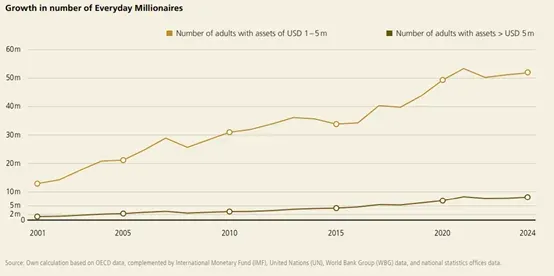
What is driving the rise of these “new rich”? According to the report, two prominent factors contributed to the wealth accumulation of everyday millionaires: rising real estate prices – which increased the value of assets owned by many in the upper middle class – and currency movements, as the weakening of local currencies against the dollar increased the value of wealth in dollar terms. The trend indicates that more “ordinary” households are joining the millionaires’ club. For the alternative investment industry and family offices, this means growth in the segment of potential clients with mid-to-high wealth – a group worth paying attention to, since its financial needs may differ from those of the traditional elite.
A Change in the Structure of Wealth and Global Inequality:
Beyond quantitative growth, the report also points to qualitative changes in the composition of global wealth. For the first time in ages, the largest stratum of the population is no longer those with meager wealth: the share of adults with less than $10,000 has declined, and the group with wealth of $10–100 thousand is now the largest in the world. In other words, more people have managed to climb into the lower-middle wealth bracket – a sign of overall growth in global living standards.
Nevertheless, inequality remains very significant. The data show that around eighty percent of adults worldwide hold assets worth less than $100 thousand, and only about 1.6% of the adult population are US-dollar millionaires. This gap between the average and the median sharpens the picture of the high concentration of wealth: in countries such as Switzerland and the US, where average wealth per adult is the highest in the world, median wealth is much lower, indicating large gaps between the middle class and the very wealthy. In contrast, countries such as Luxembourg, Australia and Belgium lead in median wealth per adult – higher even than that of the US – indicating a more equal distribution of assets across the population. These findings remind us that investors should look not only at overall growth but also at how it is distributed across the population, since social gaps may affect market stability and economic policy.
Intergenerational Wealth Transfers:
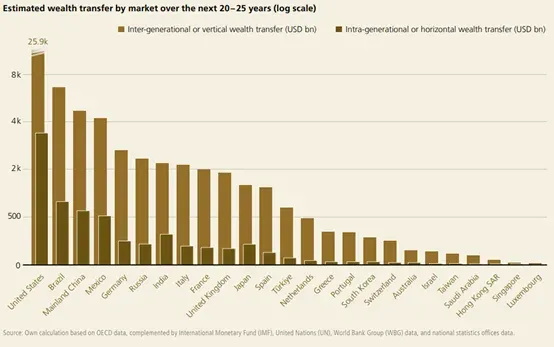
Another central part of the 2025 report deals with the future: who will receive existing wealth, and how will it pass to the next generation? Over the next 20–25 years, the investment world is expected to witness an enormous wave of intergenerational wealth transfer. More than $83 trillion is expected to be transferred through inheritance or intergenerational gifts worldwide, of which approximately 9 trillion will pass through “horizontal inheritances” – between spouses of the same generation. The remainder, approximately 74 trillion, will move from the older generation to the younger. The largest volumes of wealth transfer are expected in the US (more than $29 trillion), Brazil (~$9 trillion) and China (>$5 trillion) – a figure that reflects not only the size of the population and wealth in these countries, but also the fact that the baby boomer generation, which holds (by a wide margin) the largest share of the world’s wealth (more than $83 trillion), is aging.
This trend carries important implications for institutional investors and family offices: a wave of estate planning, trusts and asset transfers is expected that will require professional financial support. The report emphasizes that wealth is not static – it faces a “reshuffling of the deck” between the parents’ generation and the children’s generation. For wealth managers, this is an opportunity to devise strategies that will attract the younger generation of beneficiaries, as well as to offer solutions for managing wealth that will pass within the same generation (for example, the transfer of assets to a spouse upon death). In addition, it should be remembered that the way wealth is invested will change: millennials, for example, tend to hold more of their assets in real estate and private businesses compared with their parents. Shifting investment preferences from one generation to the next may affect preferences for investment channels, financial consumption trends and even liquidity in certain markets.
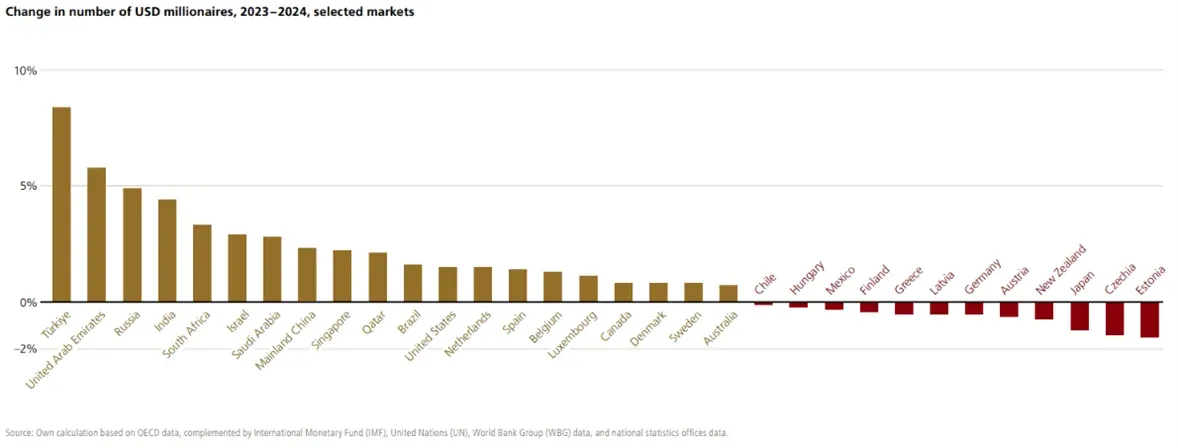
It is also important to note the impact of financial markets on the wealth picture: the sharp gains in equity markets in 2023 and 2024 significantly increased the wealth of holders of financial assets. This contributed, for example, to the addition of approximately 379 thousand new millionaires in the US in 2024 – an average of more than 1,000 additional millionaires every day. The US alone now accounts for almost 40% of all millionaires in the world, further cementing its position as a global wealth superpower. The report’s forecast for the next five years continues this line: average wealth per adult is expected to rise further, led by US markets and subsequently also by Greater China, Latin America and Oceania. In other words, the trend of wealth creation does not stop here – but it depends heavily on the continued strong performance of capital markets.
Israel in the Picture: Wealth on an Upward Trend:
And what about Israel? The data show that Israel continues to climb the global wealth rankings. In 2024, average wealth per adult in Israel rose to approximately $284,200 (approximately NIS 996 thousand) – placing Israel 17th in the world (compared with 18th the previous year). Median wealth per person in Israel also grew, reaching approximately $88,900 (~NIS 308 thousand), ranking 25th in the world (compared with 26th in 2023). This is a continuation of a positive trend in which Israel is narrowing the gap with other developed economies: in fact, the average level of wealth in Israel is higher than that of certain G7 countries such as Germany and Italy, although median wealth in Israel is lower than in many Western European countries – which suggests significant wealth gaps within Israeli society. Indeed, over the past decade average wealth in Israel has grown at a much faster pace than median wealth, indicating that the top deciles enjoyed particularly sharp growth (for example, as a result of gains in the capital market and in the value of local technology companies).
Another notable figure: at the end of 2024 Israel counted approximately 186 thousand US-dollar millionaires (assets worth more than $1M, excluding the primary residence) – an increase of ~2.9% over the previous year. This is approximately 2.6% of the country’s adult population, a rate higher than the global average (1.6%). The number of local millionaires is expected to grow in the coming years, partly thanks to the waves of IPOs and high-tech exits in previous years that made many employees and shareholders very affluent. In addition, intergenerational wealth transfer is also expected in Israel: looking ahead, it is estimated that approximately $154 billion will pass in Israel from the parents’ generation to their children (as well as between spouses) in the coming decades – an amount equivalent to approximately 9% of all private wealth in the country. This illustrates that in Israel too, inheritance planning and wealth transfer will become a central issue for wealthy families and their financial advisors.
Summary:
The Global Wealth Report 2025 offers a fascinating glimpse into the forces shaping the world of private wealth – from geographically unequal growth, through the rise of “everyday millionaires” who are widening the circle of affluent investors, to the challenges and opportunities in passing the baton of wealth to the next generation. For the financial community in Israel, these insights are not merely theoretical: they reflect trends we are also seeing in the local market – rising levels of wealth, changing investment habits and enormous economic potential, as well as the social responsibility that accompanies the concentration of wealth.
Disclaimer:
Nothing in this publication constitutes an offer to the public or an invitation to make any investment; it is a publication and presentation of general information only. The article and its content rely on information, publications and data received from third parties, which were assumed to be accurate without the company having reviewed or verified their accuracy. The information presented in this publication does not constitute investment advice/marketing or a substitute for investment advice/marketing tailored personally and specifically to each individual, taking into account their data, needs, financial situation, circumstances and investment objectives.
Sources:
UBS. (2025). Global Wealth Report 2025: Crafted Wealth Intelligence. UBS Global Wealth Management. https://www.ubs.com/global/en/wealth-management/insights/global-wealth-report.html