
U.S. Venture Capital in 2024: Between High Valuations and a Liquidity Shortage
2024 in the U.S. venture capital market was marked by a striking paradox – despite a significant decline in deal volume and exit activity, startup valuations remained high. Pitchbook’s annual valuations report for 2024 points to a market that has been sluggish for about three years, under the influence of high interest rates and inflation, yet with median company valuations still rising relative to prior years. Behind these figures lies the story of a market in transition: from investors who are cautious due to macro conditions and thin liquidity, to the emergence of artificial intelligence as a partial “savior” that is driving deals and sparking hope. Below are the key trends that emerged from the report:
Trends in valuations and deal count:
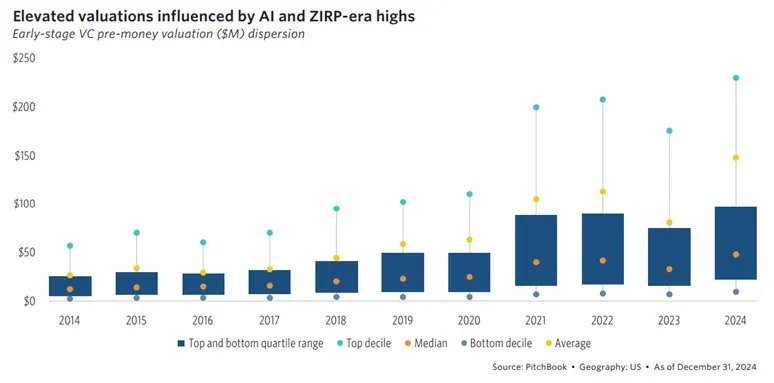
The past three years have brought a sustained cooling in investment activity. In 2024, the number of deals fell to its lowest level since 2019, reflecting investor caution in a challenging economic environment. Paradoxically, however, median startup valuations rose at every funding stage compared with 2022–2023. The reason for this is that many companies postponed new funding rounds to avoid down rounds, and when they were forced to raise, they mostly did so at a valuation similar to their previous round from the 2021 era. More than half of the Series C and later companies that raised in 2024 had not raised capital for more than two years prior, so their current valuations still reflect the high price levels of the pandemic period.
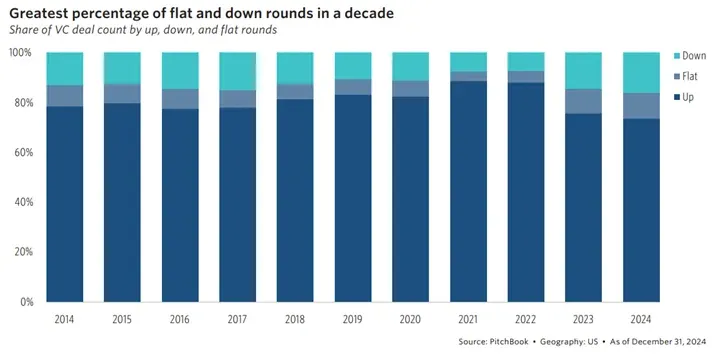
In other words, the high valuations are largely a “legacy” of the zero-interest-rate era (ZIRP) rather than the result of strong growth in recent years. A striking figure that illustrates this: approximately 26% of rounds in 2024 were flat or down rounds – the highest share in the past decade . Instead of sharp valuation increases, we are seeing relative stagnation: the round-to-round “multiple” (step-up) has steadily narrowed.
Liquidity and the difficulty of exits:
The lack of large exits is causing an “oversupply” of startups in the private market: according to the report, the value of private companies awaiting an exit totals more than $4 trillion – more than twice the value in 2020. This means that venture capital investors are left with larger-than-planned portfolios without sufficient capital returns, and as a result many of them are hesitant or unable to commit new capital to funds. Everyone expected interest rate cuts to help reopen the IPO market, but in practice the three limited rate cuts of 2024 had almost no effect, and the two cuts expected in 2025 are not expected to work wonders.
The result is a stagnant exit market: in 2024, only five technology unicorns went public through an initial public offering (IPO), and two of them were forced to reprice themselves at a significant discount. Reddit, for example, filed its prospectus in early 2024 after cutting its internal valuation by more than 50% from its peak – but after the IPO its market value in the public market jumped to approximately $37 billion. This trend is also reflected in broader statistics: in Pitchbook’s quarterly index, in five of the last eight quarters the median IPO step-up was below 1x – meaning that for most companies, the IPO valuation fell compared with the last private round. In the public market, investors today are unwilling to pay the prices most private companies would need in order to go public, given the decline in valuations and the demand for stability and profitability. The mergers and acquisitions (M&A) front is also challenging: the total exit value via M&A was estimated at only approximately $82.6 billion in 2024 – the lowest level in the past decade. The bottom line: until more startups are willing – or forced – to cut their valuations in order to exit, the recovery in the venture capital market will remain slower than the market needs.
Key macroeconomic influences:
The market contraction was accompanied and exacerbated by significant macro factors. Foremost among them was an environment of high interest rates and inflation: after a decade of cheap money, the rapid rise in interest rates in 2022–2023 raised the cost of capital and reduced risk appetite. In 2024 as well, interest rates and inflation remained at high levels, which sustained the slowdown in investment. Investors are now pushing harder for efficiency and real growth. At the same time, the public equity market underwent a sharp correction that spilled over into the private market: valuation multiples of public technology companies plunged from their 2021 peaks back to a more moderate historical level, making it harder for private companies to justify an IPO at the valuations that were customary in the past. Indirect effects, such as tighter regulation of mega-acquisitions in prior years, also created an exit “bottleneck.” Looking ahead, a continued decline in inflation and a reversal of the interest rate trend could provide a tailwind for the industry, but the gap between past and present conditions will require careful adjustment by the market.
The impact of artificial intelligence (AI) on the market:
Against the backdrop of generally cautious sentiment, artificial intelligence stood out as a significant bright spot in 2024. Investment in AI soared and became a substantial part of market activity: close to 30% of the number of deals and approximately 46% of total deal value that year were in startups focused on AI. In fact, the five largest financing deals of 2024 were all in AI companies. This phenomenon made the overall market data look better than the actual situation – the rise in median valuations is explained by large AI deals pulling the average upward. AI’s influence on the industry was so dominant that some view it as an almost separate market.
Challenges and opportunities for investors:
For venture capital investors, the reality of 2024 was full of challenges on the one hand and opportunities on the other. On the challenges side, first and foremost is the liquidity problem: funds are struggling to realize returns and capital is “locked up” in portfolios for long periods, which also makes new fundraising harder because funds are unable to show capital returns to investors. Moreover, the pricing gap between the private and public markets puts investors in a dilemma – how to price new rounds in an environment where historical valuations are high, but the exit market prices lower. Many of the startups in the exit pipeline will probably have to accept valuation cuts in order to go to market, which could hurt returns on the original investments. Longer holding periods have also become a reality: since companies are waiting longer between funding rounds, investors are required to support companies for longer than planned, sometimes with additional bridge investments, while patiently waiting for an exit that is not imminent. Finally, the concentration of many investments in a single field (AI) means fierce competition for the same deals, at very high valuations, while other fields may offer opportunities that find it harder to secure funding.
On the opportunities side, periods of slowdown are often the best time for investors. Reduced competition for deals makes it possible to obtain better investment terms and attractive valuations in good companies that are struggling to raise capital. The secondary market may also become more active – employees and longtime shareholders need liquidity and may agree to sell part of their holdings at a discount. In addition, the slowdown has forced companies to focus on business efficiency and clear paths to profitability – which in the long run will benefit the quality of investments. When macro conditions eventually improve (for example, a significant decline in interest rates or stabilization of the public markets), investors who acted judiciously during the downturn may reap the rewards through improved exits. At the same time, preparing for change is the key: funds’ flexibility in investment structure, patience with realizations, and the ability to identify trends (such as climate and new technologies) will be an advantage. In summary, 2024 was a year of correction and waiting for this asset class – a year in which growth rates may have moderated, but the seeds of the next opportunities were sown. Investors who position themselves correctly now, aware of the risks but also open to the possibilities, will be well placed to take advantage of the recovery when it comes.

Sources: https://pitchbook.com/news/reports
Disclaimer: Nothing in this publication constitutes an offer to the public or an invitation to make any investment; it is a publication and presentation of general information only. The article and its contents rely on information, publications and data received from third parties, which were assumed to be accurate without the Company having reviewed or verified their accuracy. The information presented in this publication does not constitute investment advice/marketing or a substitute for investment advice/marketing tailored personally and specifically to each individual, taking into account their particulars, needs, financial situation, circumstances and investment objectives.