
Does Venture Capital in Israel Have a Future in Light of Recent Challenges?
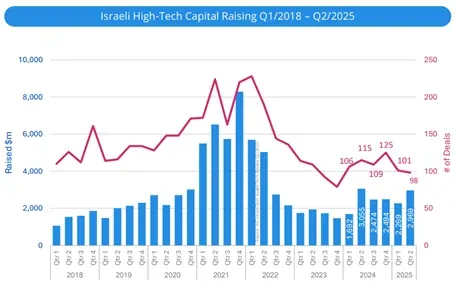
The first half of 2025 in Israeli high-tech was marked by a continuation of the trends of 2024, with cautious adjustments to a challenging geopolitical and economic environment. Despite local uncertainty (the security situation) and global volatility (such as the effects of inflation and regulatory risks in the US), capital continued to flow into Israeli high-tech – albeit on more conservative terms and at a higher risk premium than we have grown accustomed to. Total funding in this half approached $4 billion across some 98 deals, a figure that reflects the enduring strength of Israeli high-tech alongside a change in investment patterns. A decline in the number of deals while capital volumes held steady, a shift toward follow-on rounds and large investments, and the rise of new fields such as Generative AI – all of these are reshaping Israel’s investment map.
The data reveal a widening gap in fundraising performance across company stages. Early-stage rounds (Seed and Series A) show persistent weakness: after the investment boom of 2020–2021 came a phase of “normalization,” in which funding volumes and deal counts have been falling for several consecutive quarters. In fact, the contraction is particularly pronounced in early-stage rounds, and especially in Seed and Series A raises. Companies without financial backing from established investors are now finding it harder to raise capital. Since Q4 2024 the early-stage trend has been negative, with declines in both the number of deals and the amounts invested. By contrast, later-stage companies enjoy an advantage: because they already have existing VC investors, they are succeeding in attracting larger investments even in this cautious period. In practice, Q2 2025 saw an increase in investment volumes in mid- and late-stage (growth-stage) rounds: funding amounts at the mid and late stages continued to grow, with the median mid-stage round reaching a new record this quarter. In other words, investors are concentrating resources in more established companies, while young companies without a “seal of quality” struggle to raise funds.
A Shift in Investor Activity: First-Time vs. Follow-On Investments:
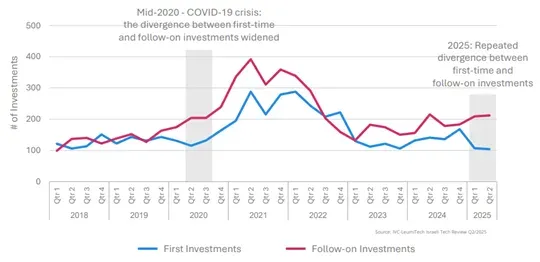
One of the clearest indicators of the state of the market is the ratio between new (first-time) investments and follow-on investments in the existing portfolio. Until 2019 the two tracks moved together, but since the COVID-19 crisis in 2020 a gap has opened in favor of follow-on investments. In the first half of 2025 this gap was felt again in full force: first-time investment activity declined, while support for existing portfolio companies through follow-on investments is on an upward trend. In the second quarter of the year there was a slight recovery in first-time investments across all investor types, but among VC funds the trend remained negative. This pattern is reminiscent of how funds behaved at the outset of the COVID-19 crisis – focusing on stabilization and investing in existing companies rather than taking on new risks. For investment managers, the implication is clear: in times of uncertainty, “smart” money prefers to prevent dilution and secure the health of the current portfolio before embarking on new adventures. This trend could change quickly if and when the uncertainty dissipates, but for now Seed-stage companies without existing investors are experiencing particular difficulty in raising capital.
The Cyber Market vs. the Rise of Generative AI:
The cybersecurity sector, which has been the locomotive of Israeli high-tech in recent years, faces challenges in light of the emergence of a new “star” – generative artificial intelligence. Cyber remains the leading sector for investment in terms of total capital, but its activity patterns have changed: during the peak period of 2020–2022 more than 250 cyber deals closed in Israel, whereas in the two years that followed the pace of deals was almost cut in half. Despite the slowdown, cyber companies still attract more capital than any other technology sector in the country. At the same time, however, “with AI taking center stage, some investors have begun to question the long-term attractiveness of the cyber sector. Some of the sector’s former unicorns have lost value (“ex-unicorn” companies whose valuation has fallen below $1 billion), and companies that were marked as leaders during the boom now face hard questions about growth and the path to an exit.
On the other hand, there are still signs of success in cyber: the announcement of Google’s acquisition of Wiz for approximately $32 billion restored positive sentiment to the market and highlighted the enduring strategic value of large cyber assets. In fact, an IVC analysis shows a 69% correlation between capital raised and exit value in M&A transactions in the sector in recent years – so a cyber sector that has raised a great deal may still deliver handsome returns. The artificial intelligence sector gained impressive momentum in the first half of 2025, to the point that, together with cyber, these two fields were the most dominant in terms of investment volume in Israel during this period. Generative AI startups attracted substantial interest and capital, and it is fair to say that the competition for attention and capital between AI and cyber is in full swing. In addition, it is worth noting that defense technology (Defense Tech) also gained momentum in the last quarter of the period, with an increase in deal volume – possibly influenced by the regional geopolitical situation. A relatively large number of Israeli funds in this field are planning to launch, hoping to raise capital against the backdrop of global trends of rising defense budgets and the proven capabilities of the Israeli industry.
Funding Concentration – The Impact of Mega-Rounds:
One of the most notable phenomena in 2025 is the share of mega funding deals in the overall picture. “Mega deals” are defined as funding rounds of exceptional size (above $50 million or $100 million). In Q2 2025 alone, 17 rounds of more than $50 million each closed, with a total value of approximately $2 billion – the highest quarterly level since Q3 2022. These large deals accounted for approximately 68% of all capital raised in the quarter, meaning that about two-thirds of the money went to a small number of companies at advanced growth stages. The reason for the surge is an unusual proliferation of “mid-to-large” rounds ($50-100 million each) within a short period of time. Looking at the half as a whole, mega-rounds above $100M also continued to take place, but their volume appears to have stabilized and did not grow compared with the same period last year. It is important to note that such high concentration can distort the picture of the market: a small number of mega deals “inflates” total investment and creates the impression of strong activity, while in practice core activity (the broad layer of small/mid-sized deals) is weaker. Metrics excluding exceptional deals (outliers) should also be examined in order to understand the true market trend. For strategic investors, the implication is caution in interpretation: not every increase in total investment reflects a bull market – sometimes it is simply the result of a few large deals channeling a great deal of capital.
The Pace of Exits, IPOs and Mergers & Acquisitions (M&A):
The exit market in the first half of 2025 showed slight signs of recovery, though it is far from returning to its peak days. In total, 62 exits were recorded in the half, with an aggregate value of approximately $5.55 billion. It should be noted that a considerable part of this amount stems from a single mega deal: Xero’s acquisition of Melio for approximately $2.5 billion, which “inflated” the total value. Excluding it, exit volume is still modest. In terms of count, the 62 exits represent a slight decline compared with the second half of 2024, but still an improvement compared with the trough recorded in 2023. For perspective, before the 2021 boom the pace averaged around 80 exits every six months – the current level is still below that. On the IPO front, activity was extremely limited: only two Israeli companies went public in all of H1 2025 (both in the second quarter), following just six IPOs in all of 2024. Despite the scarcity of IPOs, eToro’s Nasdaq IPO at a post-IPO valuation of $4.4 billion stood out in particular – one of the largest Israeli IPOs in recent years. On the M&A front, several major deals were announced but had not yet closed by the end of the half: Google announced its intention to acquire Wiz for $32 billion, and the insurance company ERGO announced the acquisition of Next Insurance for $2.6 billion – if and when they close, these deals will represent a tremendous exit for shareholders. Bottom line, the exit market remains challenging – the IPO window remains narrow, and most returns come from company sales at low prices or from a handful of “mega-value” exits. Nevertheless, the overall trend is more positive than in 2023, pointing to a market that is beginning to stabilize and is waiting for suitable opportunities.
Investors’ Geographic Focus – Foreign vs. Israeli:
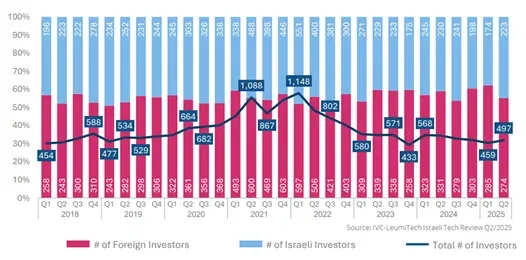
The question of capital sources is a key factor in understanding the market. In periods of uncertainty the question arises: are foreign investors retreating and leaving the arena to local players, or is global capital still flowing into Israel? The report’s data paint a mixed picture. Foreign investors continue to play a very significant role in financing Israeli high-tech – global capital is “still available” for Israel, and in particular led a considerable portion of the large funding rounds. At the same time, it appears that Israeli investors captured a not-insignificant, and even nearly equal, share of the pie in the first half of 2025. In fact, the split between foreign and local capital among investors was almost balanced in this period, evidence that Israeli institutional investors and funds stepped up their activity at a time when their foreign counterparts became more selective and cautious. Foreign capital is indeed “present but cautious,” and today demands a higher price for risk – but there has been no flight of international funds. For company executives and investors alike, this underscores the importance of cultivating a local investor network in parallel with approaching foreign investors: in times of crisis, local investors may be the ones who continue to provide support when others hesitate.
Summary – Insights and Outlook:
The first half of 2025 proved to be a transitional period in which Israeli high-tech navigated between ebb and flow, with encouraging signs alongside ongoing challenges. Strategically, during this period investment managers focused on support from within – strengthening promising portfolio companies so that they would not lose altitude at a time of scarce new investment. It will be interesting to follow the completion of large exits (such as Wiz) and their effect on market sentiment – a single successful deal can restore the appetite for risk. In addition, attention should be paid to mega-rounds: although they inject oxygen into mature companies, a proliferation of deals of this kind may point to risk concentration and mask a liquidity crunch among younger startups. These points, together with continued monitoring of the relevant market metrics, will help navigate this complex period wisely and prepare better for the second half of 2025.
Disclaimer:
Nothing in this publication constitutes an offer to the public or an invitation to make any investment; it is a publication and presentation of general information only. The article and its content rely on information, publications and data received from third parties, which were assumed to be accurate without the company having reviewed or verified their accuracy. The information presented in this publication does not constitute investment advice/marketing or a substitute for investment advice/marketing tailored personally and specifically to each individual, taking into account their data, needs, financial situation, circumstances and investment objectives.
Sources:
The report “IVC-LeumiTech Israeli Tech Review Q2/2025” (June 2025) and IVC data.