
Data Centers in the Era of Cloud and Artificial Intelligence
The artificial intelligence (AI) revolution is unfolding at unprecedented speed: advanced AI applications require enormous computing power and vast data storage, and at the center of this phenomenon are data centers – “the core infrastructure powering artificial intelligence.” An analysis of global trends shows that the shift to cloud services and the growing adoption of AI are creating enormous demand for upgrading and expanding data center infrastructure.
The growth of cloud services and the proliferation of AI applications are placing an enormous load on computing infrastructure. Approximately 90% of global IT budgets are still spent on on-premises systems, leaving vast room for cloud services to grow. At the same time, Pimco reports indicate that the capital expenditures (CapEx) of technology companies continue to rise, with more and more investment directed to digital infrastructure for cloud and AI. In other words, most of the budget being invested today is directed toward upgrading and expanding servers and data centers, to support growing demand for cloud services and new AI capabilities.
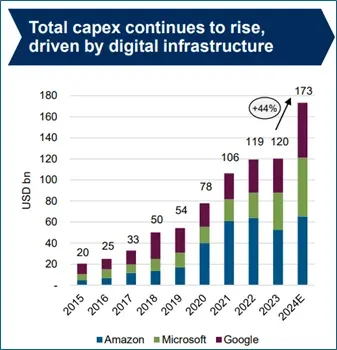
In recent years, data centers have become an attractive investment target in light of steady and pronounced growth in demand from cloud and artificial intelligence. These trends underpin long-term demand: the data show that the expansion of cloud services and a wide range of AI applications are displacing legacy projects and creating a springboard for investment in the infrastructure required for high-performance computing. The main advantages of investing in data center infrastructure can be summarized as follows:
- Stable, sustained demand: Data centers are core infrastructure for the digital economy – from hosting cloud services to advanced AI networks. Demand for them is therefore insulated from extreme fluctuations and supported by long-term shifts in business models. In fact, in the U.S. alone, approximately 5,000 megawatts of additional data center capacity are planned this year, equivalent to about 1% of national electricity consumption.
- Technology drivers – cloud and AI: These areas are disrupting the computing status quo and shifting resources toward data centers. Industry analysis estimates that by 2030, between 60% and 70% of total global data center capacity will be dedicated to processing AI workloads, and computing and energy needs will grow by hundreds of percent. This trend is driving a boom in capital expenditure (CapEx) – the major cloud service providers are increasing their investment in facilities for GPUs and advanced analytics year after year.
- Physical infrastructure potential: Data centers combine a significant real estate component – specialized land, power and cooling systems, and communications infrastructure – similar to industrial infrastructure capital. Investing in data center assets offers high and stable rental income (similar to a REIT) alongside tangible asset value. Financial analysis adds that the scale of planned global data center investment is enormous – for example, in the U.S. it is estimated that more than $1 trillion will be invested over the next 5 years, with another $1 trillion globally.
- Diverse investment channels: It is possible to invest directly by acquiring assets and data centers (such as purchasing land or operational buildings), but indirect investment vehicles have also emerged. There are dedicated infrastructure funds focused on investing in digital infrastructure projects – both on leading stock exchanges and through private investments by investment firms.
The combination of unprecedented demand, massive infrastructure, and high consumption of energy and computing power creates an investment opportunity. More broadly, global research indicates that AI requirements will increase data center growth by tens of percent in the coming years, with approximately 70% of global capacity soon to be invested in AI-ready facilities. At the same time, because the number of sites available for building data centers is not growing at the same pace, existing projects are gaining value, and companies have an incentive to expand their capital investment ahead of an immediate scale-up of digital and AI services.
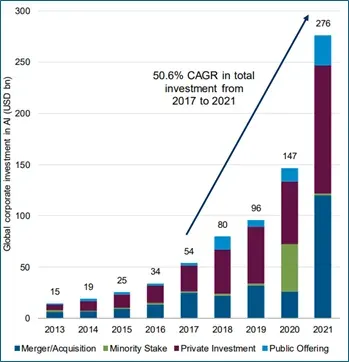
Alongside the advantages noted above, there are also several risks to take into account:
Peak hype – high acquisition prices and valuations:
The enormous demand has generated significant hype around the sector: the valuations of data center companies have soared, and a considerable portion of the assets now trade at very high valuations. High acquisition costs are also evident in the private market, with many deals closing at valuations that would previously have been considered especially aggressive.
A flood of capital – the entry of alternative funds:
Large amounts of capital are flowing into the sector: almost every major investment firm or leading alternative asset manager has launched a dedicated data center fund or is managing investments in the space. This means that supply is expected to grow significantly over the next two years, with many projects already in development.
Expected oversupply in the coming years:
According to a Goldman Sachs report, the base-case scenario projects that demand will continue to grow until it peaks at the end of 2026, but will subsequently weaken as a result of an oversupply of new data centers currently under construction (see the attached chart from the report). In other words, many investments being advanced today may mature precisely when the market begins to show signs of saturation.
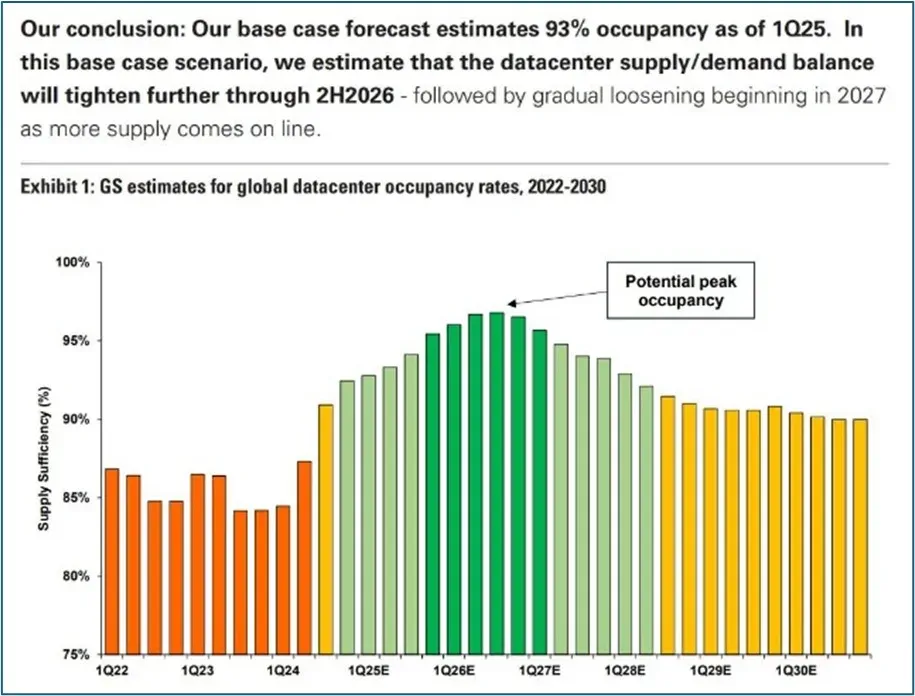
The demand side may weaken too:
In addition to the supply-side risk, the demand side is also showing early signs of slowing: some of the leading technology companies have already announced cuts to their capital budgets. If this trend broadens, it could reduce new demand for data centers and weigh on expected returns on investment.
Summary:
Data centers are an integral part of the era of artificial intelligence and the cloud, and today offer an investment alternative alongside emerging risks. In light of the challenges taking shape, investors should adopt a more cautious approach: favor selective, high-quality investments, rigorously examine the development and energy capabilities of each project, and continuously monitor technology and regulatory markets. Attractive returns are likely to be achieved by combining direct exposure to leading assets with investment in supporting energy infrastructure.
Disclaimer:
Nothing in this publication constitutes an offer to the public or an invitation to invest of any kind; it is a publication and presentation of general information only. This article and its contents rely on information and published data received from third parties, which were assumed to be accurate without the company having examined or verified their accuracy. The information presented in this publication does not constitute investment advice/investment marketing, nor is it a substitute for investment advice/investment marketing tailored personally and specifically to each person, taking into account their data, needs, financial situation, circumstances and investment objectives.
Sources:
PIMCO presentation (October 2024): Data Centre Demand in Light of Hyperscaler Growth and AI.
Goldman Sachs Global Investment Research, Global Datacenters: Introducing the GS Datacenter Supply/Demand Model – We See a Tightening Market Through 2026.