
Search Funds: Recent Trends and Opportunities for Investors
Search funds are an entrepreneurial investment model in which investors finance an entrepreneur, or a pair of entrepreneurs, with the aim of acquiring and leading a private company. An updated 2024 study by the Stanford Graduate School of Business surveys 681 search funds formed since 1984 in the US and Canada, examining their financial performance and characteristics through the end of 2023. The data point to exceptionally high returns over time (an average internal rate of return of ~35% per year), alongside new market trends – among them growth in the number of funds, declining valuations in recent transactions, and a shift in the searcher profile (more young entrepreneurs and more women). For institutional investors and family offices, understanding the search fund model matters given its potential for excess returns and its emergence as a developing investment channel. In recent years we have seen a significant increase in search fund formation (a new record in 2023) and in the capital flowing into them – a sign that the model is becoming established as an attractive alternative for direct investment in private companies in the SME segment. Below we analyze the structure of the model, recent trends, and its advantages and disadvantages, and examine the implications for institutional and private investors.
The Search Fund Model – Background and Structure:
A search fund is an entrepreneurship and investment path in which an individual or a pair (the “searchers”) raise a small fund from a group of private investors in order to identify, acquire and operate a private company over the medium-to-long term (6–10 years). The investors are not entirely passive; many of them serve as mentors, supporting the searcher throughout the search and operating phases. The model was born at Harvard in 1984, was later adopted at Stanford, and has since been embraced across the business and academic worlds. The life cycle of a search fund typically divides into four stages: raising the fund (investors contribute initial capital to finance the ongoing search activity); searching for and identifying a suitable company to acquire; acquiring the company and transferring ownership; and finally, managing and operating the acquired company over several years with the intention of enhancing its value, and only then realizing the investment through an exit. When it succeeds, the process creates a win-win: the searcher becomes, relatively quickly, the owner-CEO of a mid-sized company; the investors enjoy an attractive financial return; and the company itself grows and becomes more efficient under new leadership.
Recent Trends in the Search Fund Market:
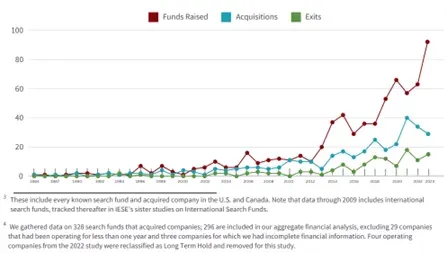
Following moderate expansion at the start of the decade, activity in the search fund sector regained momentum in 2023. The number of new funds formed in 2023 jumped to 94 – the highest ever – compared with relative stability in 2021–2022. This growth is attributed to a combination of rising awareness of the model (more entrepreneurs are learning about it in ETA – Entrepreneurship Through Acquisition – courses) and the increasing availability of capital from investors interested in this channel. At the same time, the number of acquisitions actually completed in 2023 fell to 29, a decrease of 11 transactions compared with the peak year of 2021. 2021 stood out for a sharp jump in the number of successful acquisitions, partly as a catch-up after delays during the COVID-19 pandemic – once restrictions were lifted, transactions that had been waiting to close came back. Following that correction, the pace of acquisitions moderated in 2022–2023 to more “normal” levels, though still high by historical standards.
The volume of capital invested in the model remains significant: in 2022 and 2023 combined, approximately $682 million was invested in search funds and in the companies acquired through them. Although this amount is about 94 million lower than in the preceding two years, it indicates that institutional and private investors continue to channel capital into the space on a broad scale. The decline may stem in part from the slightly lower number of acquisitions in this period.
Following acquisition, some funds have already realized their investment through a sale of the company (exit). The number of exits in 2022–2023 remained similar to the number in the previous two years. In other words, there has been no significant increase or decrease in the pace of realizations recently, suggesting that investors are still holding a large share of the acquired companies and continuing to manage them (a long-term hold in practical terms, though not necessarily in a formal LTH structure).
Fund Performance and Investor Returns:
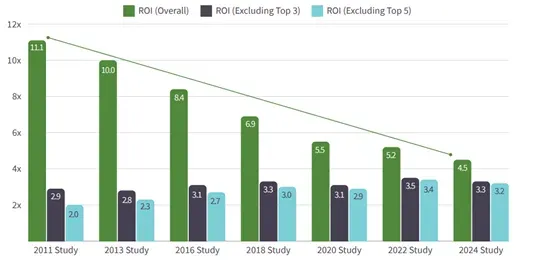
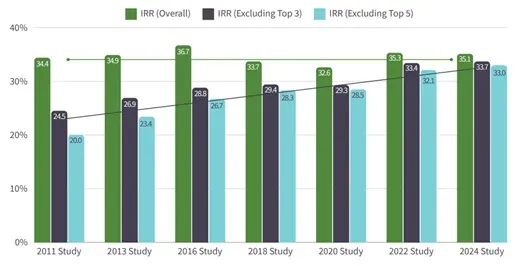
Search funds have demonstrated an impressive performance track record. Across all funds (including those that failed and did not acquire a company), the average annual internal rate of return to investors (IRR) stands at 35.1% and the cumulative return on investment (ROI) is 4.5x the original investment, as of the end of 2023. These figures are very similar to the findings of the previous study (2022), indicating consistency: the slight decline from 35.3% to 35.1% in IRR and from 5.2x to 4.5x in the capital multiple is relatively negligible. For investments realized through an exit (i.e., a sale of the company after several years of ownership), returns are even higher: an average IRR of approximately 42.9% (up from 36.8% previously) was reported for funds with an exit, following several particularly successful sales over the past two years. The sharp increase in this category is attributed to a few exceptional exits that generated very substantial profits for investors in 2022–2023.
That said, it is important to note that performance varies widely from fund to fund. The distribution is wide: some investments generate high double-digit exit multiples, while others end in a loss of investor capital. In fact, the study found that when the 3–5 largest successes are excluded, average returns do decline somewhat (~30% IRR instead of 35%), but still remain impressive. This indicates that even without the “outliers,” the model consistently generates high returns. On the other hand, the risk of loss is real: search funds that failed to acquire a company (approximately 43% over the past decade) effectively lost the capital invested to finance the search, and even among the funds that did acquire a company, some of the acquired companies failed and produced a negative return (a loss) for investors. This means that an individual investor in a single search fund may experience a relatively binary outcome – a very high return or a loss – depending on the success of the searcher and the acquired company. Nevertheless, from a broader perspective, the sector’s historical data are, as noted, highly attractive.
Source: E870 – Kelly, Peter & Heston, Sara (2024). 2024 Search Fund Study: Research Overview. Stanford Graduate School of Business (Case No. E-870, June 28, 2024).
Advantages of the Search Fund Model:
- Potential for excess returns for investors: Search funds have a track record of exceptionally high returns – an average internal rate of return (IRR) of ~35% per year and a cumulative investment multiple of ~4.5x over several decades. These figures are far higher than is typical in traditional private investments, and point to the potential for significant alpha for investors who know how to select the right investments.
- Investor involvement and active value-add: Unlike passive investment funds, in this model the investors are typically experienced individuals who also act as partners and mentors to the searcher. These investors provide the searcher with guidance, advice and access to their networks – increasing the likelihood of success both in the search and in managing the company after the acquisition. In addition, given the small size of the investor group, there is strong alignment of interests between the searcher and the financiers throughout the life of the deal.
- Target companies with growth potential: Companies acquired by search funds tend to be in good shape with an attractive financial profile – for example, in the current study the median EBITDA margin was ~27% and annual growth ~25% at the time of acquisition. This means they are generally stable, profitable businesses with growth potential that the searcher can capitalize on. Under new and motivated leadership, many of these companies grow at an accelerated pace and become improved, growing businesses – as the study documents in a large number of successful cases.
Challenges and Disadvantages:
- Risk of not finding a company to acquire: Success in the search process is not guaranteed. In practice, only about 57% of funds ultimately manage to identify and acquire a company – that is, about 43% end without any transaction at all. In these cases the searchers withdraw from the process and investors typically lose most of the capital allocated to financing the search itself.
- Long-term illiquid investment: A search fund is a multi-year commitment. If an acquisition takes place, investors’ capital is locked into the acquired company for an extended period (typically 5–10 years or even longer), with no option for an interim exit. This is a significantly longer investment horizon than that of standard private equity funds, and investors must be prepared to forgo liquidity over time and wait patiently for the final exit.
- High dependence on a single searcher-manager: The success of the investment depends almost entirely on the performance of the searcher (or the small team) who becomes the company’s CEO. This is a significant key-person risk – the management, leadership and decision-making skills of a single individual will heavily influence the company’s future value.
Alongside the classic search fund model (Core Search Fund) described above, several additional variations based on similar principles have emerged in the market:
- Self-funded search: An entrepreneur who chooses to finance the search costs on their own, without raising capital from investors into a dedicated fund. In this model, outside investment typically comes only at the acquisition stage, if and when a company is found, and the entrepreneur retains a larger stake in the company. The study mentions this variation as a common alternative to traditional funds.
- Search financed by a single entity (Single Investor/Accelerator): A model in which a single investor or institutional investment entity (such as a large fund or a family office) finances all of the searcher’s search costs. This model sometimes operates within Entrepreneur-in-Residence programs or accelerators, in which the searcher operates under the sponsorship of a single financial entity rather than a group of investors. The advantage for the searcher is a simpler fundraising process and solid financial backing, while the investor gains exclusivity over the investment opportunity.
- The “Long Term Hold” model (LTH): A relatively new variation that is a subtype of Committed Capital Vehicles (CCV). In an LTH fund, unlike a regular search fund, larger capital is committed to the fund at launch, with a more focused and narrower thesis regarding the type of businesses to acquire, and a particularly long holding horizon – a minimum of 10–20 years before exit. LTH funds grow more slowly in their early years (with an emphasis on building the portfolio organically, often through add-on acquisitions – roll-ups), and the incentives of the searcher and the investors are structured for the very long term. Stanford identified growth in LTH fund formation in recent years (22 funds were identified in the study) – they are not included in the main quantitative analysis due to their novelty, but they point to a willingness among some investors and entrepreneurs to adopt an even longer-term approach.
Disclaimer:
Nothing in this publication constitutes an offer to the public or an invitation to make any investment; it is a publication and presentation of general information only. The article and its content rely on information, publications and data received from third parties, which were assumed to be accurate without the company having reviewed or verified their accuracy. The information presented in this publication does not constitute investment advice/marketing or a substitute for investment advice/marketing tailored personally and specifically to each individual, taking into account their data, needs, financial situation, circumstances and investment objectives.
Sources:
E870 – Kelly, Peter & Heston, Sara (2024). 2024 Search Fund Study: Research Overview. Stanford Graduate School of Business (Case No. E-870, June 28, 2024).