
Are Continuation Funds Living Up to Expectations?

In recent years, continuation funds have been gaining momentum as a significant investment channel in private markets. Originally, these funds served as an alternative to an exit for high-quality, mature assets that the fund’s general partners wished to continue holding for an additional period. Today, they have become a strategic tool that provides new investment opportunities for institutional and private investors. The performance report published by Evercore Private Capital Advisory in the second quarter of 2024 presents data on the performance of continuation funds in recent years, comparing them with traditional private equity funds.
The Growth of the Continuation Fund Market
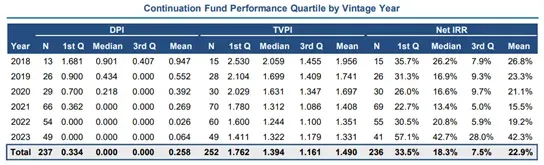
Activity in the continuation fund market is growing rapidly. Since 2018, they have become a significant alternative to an exit, mainly for assets that generated high returns and in which fund managers saw further potential for value creation. In 2024, the study collected data on 252 continuation funds formed between 2018 and 2023, a figure representing an increase of 80% compared with the 140 funds analyzed in the corresponding 2023 report. Moreover, the number of funds participating in the study nearly tripled, which reflects the market’s desire to develop clear performance benchmarks and to examine this investment channel in depth.
Returns and Performance Patterns
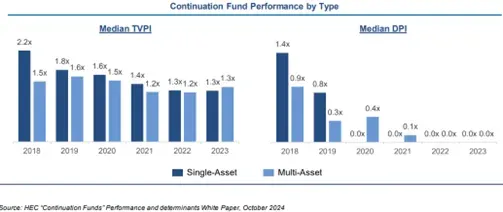
An analysis of continuation fund performance reveals interesting trends. Single-asset funds show a slightly higher TVPI compared with multi-asset continuation funds. This difference is consistent with the higher risk premium associated with a concentrated investment in a single asset. On the other hand, multi-asset continuation funds show earlier DPI, a result of risk diversification and the ability to realize assets at different stages over the life of the fund. Another interesting finding is that the average net IRR for continuation funds formed between 2018 and 2023 stands at 22.9%. Older funds (2018–2019) show higher returns, while funds formed in recent years still need to prove their performance over time.
Continuation Funds Compared with Private Equity Funds:
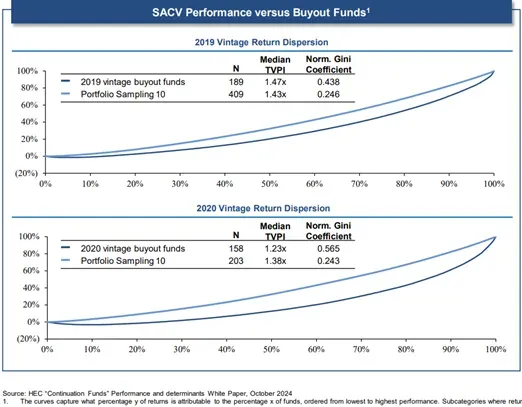
One of the central questions raised by investors is how continuation funds compare with traditional private equity funds. In a study conducted by HEC, the performance of continuation funds was analyzed against private equity funds by constructing “simulated portfolios” of single-asset continuation vehicles (SACVs), in order to examine the similarity between them. The findings showed that single-asset funds achieve returns similar to traditional private equity funds, but with lower dispersion of returns. In other words, continuation funds benefit from positive selection – fund managers actively choose to reinvest in the highest-quality assets, unlike private equity funds, which may also include assets with lower value-creation potential.
What Does This Mean for Investors?
The implication for investors is that continuation funds aim to provide access to established assets, with more moderate risk and potentially attractive returns. For institutional and private investors interested in investments with a longer time horizon, these funds can serve as a tool for strategic capital management, enabling continued value creation from proven assets.
However, although the results presented so far are positive and encouraging, it is important to remember that continuation funds are still an evolving category in private capital markets. Their long-term performance is still being tested, and therefore investors interested in exposure to this channel should closely monitor the development of the market and the future performance of the funds.
Summary
Continuation funds are not a passing trend – they provide an innovative addition to private investment allocation management, but like any alternative investment, they require in-depth research and rigorous risk analysis. As the market continues to develop and we accumulate more data on fund performance over time, it will be possible to make better-informed investment decisions.
Disclaimer:
Nothing in this publication constitutes an offer to the public or an invitation to make any investment; it is a publication and presentation of general information only. This article and its contents rely on information, publications and data received from third parties, which have been assumed to be accurate without the Company having reviewed or verified their accuracy. The information presented in this publication does not constitute investment advice/marketing or a substitute for investment advice/marketing tailored personally and specifically to each individual, taking into account their particulars, needs, financial situation, circumstances and investment objectives.
Sources:
Evercore. Q2 2024 Continuation Fund Performance Report. Evercore Private Capital Advisory, Oct. 2024.