
Semi-Liquid Funds – Between Accessibility and Structural Complexity: Trends, Advantages and Risks
Semi-liquid funds are investment funds that provide access to private markets while offering investors limited liquidity. Unlike conventional mutual funds with daily liquidity, semi-liquid funds restrict redemptions to periodic dates (for example, once a quarter) or to special arrangements. In this sense they are “semi-liquid”: they are not locked up for many years like traditional venture capital or private equity funds, but nor do they offer full daily liquidity. The common fund structures in this category include:
Interval Funds – closed-end funds that are not listed on an exchange and are run in a format resembling a mutual fund, but with built-in periodic redemptions. An interval fund issues shares continuously at NAV (net asset value) and is required to offer investors a redemption window at fixed intervals (usually quarterly, and sometimes monthly or semi-annually). At each such redemption date, the fund must offer to repurchase at least 5% of total assets. Interval funds are generally open to a broad investor base, including retail investors, subject to minimum investment requirements and platform restrictions (for example, as of 2025 they cannot be purchased directly through major retail brokers without an advisor).
Tender-Offer Funds – non-traded closed-end funds that allow the purchase and redemption of shares in accordance with decisions of the investment committee (in effect, periodic tender offers at the board’s discretion). Like interval funds, they are not listed on an exchange, are priced at NAV, and issue shares on an ongoing basis. Unlike interval funds, however, the redemption schedule has no predetermined dates; the timing and size of redemptions are at the fund’s discretion and subject to board approval. These funds usually require investors to be qualified (for example, institutional investors or “qualified investors” as defined by regulation).
Non-Traded BDCs - (Nontraded Business Development Companies) A BDC is a dedicated investment company that specializes in lending to and investing in private companies (essentially a private credit fund in corporate form). A non-traded BDC raises capital from investors on a continuous basis, prices its shares at NAV, and permits limited redemptions at the company’s discretion (similar to a tender-offer mechanism, usually quarterly). BDCs are subject to a distinct regulatory regime: they may use higher leverage – up to a 2:1 debt-to-equity ratio (i.e., debt equal to 66.7% of assets) – compared with only 1:2 for interval and tender-offer funds (debt of up to 33.3% of assets). This is one reason why BDCs (as we will see below) generally offer higher yields, but at the cost of increased risk.
Non-Traded REITs - private REITs (Real Estate Investment Trusts) that raise capital for real estate or infrastructure projects without being listed for trading. The non-traded REIT structure is similar in many respects to a BDC: continuous issuance of shares at NAV, limited liquidity at the company’s discretion, and investor eligibility requirements. Unlike ’40 Act funds (interval/tender-offer), there is no statutory leverage cap for REITs, although in practice they tend to maintain a moderate debt-to-assets ratio (usually 30%-60% debt relative to assets). Private REITs have gained considerable popularity recently, but recent market events have shown that their limited liquidity can be a point of vulnerability.
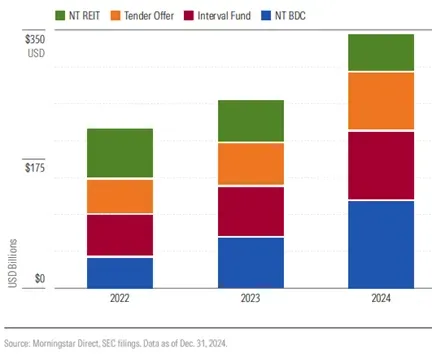
Assets in semi-liquid funds jumped by roughly 60% in two years, reaching approximately $344 billion at the end of 2024 (compared with $215 billion in 2022) – growth driven by demand for the higher and seemingly more stable returns of private markets. Most of these funds invest, in varying proportions, in private equity, private credit or private real estate. Many investors are attracted not only by the higher return potential but also by the low volatility that illiquid assets sometimes exhibit – a relatively “smooth volatility” compared with equities and bonds in public markets. That said, it is important to stress from the outset that this “smooth volatility” can be a dangerous illusion: the assets do report stable values because valuations are periodic rather than continuous, but the risks embedded in them are real (infrequent pricing can mask declines in value). In other words, semi-liquid funds offer a bridge between the two worlds – access for the mid-tier investor to alternative investment strategies – but at the cost of structural complexity, high fees and limited liquidity compared with traded funds.
One of the most notable findings in the Morningstar report is that, by investment category, private credit funds have become the largest and fastest-growing category in the semi-liquid fund universe. As of the end of 2024, private credit funds held approximately $188 billion in assets – a sharp jump from only about $75 billion at the end of 2022. Credit has thereby displaced real estate/infrastructure from first place. In fact, private credit has been the main engine of market growth over the past three years. Conversely, private real estate and infrastructure funds are the only group to have suffered a decline in assets during this period: their assets fell from approximately $91 billion at the end of 2022 to approximately $74 billion at the end of 2024. The decline was the result of a broad wave of redemptions.
Why is private credit so dominant? Steady cash flow and attractive yield: Private credit funds provide investors with ongoing monthly interest income, unlike private equity funds, where most of the profit arrives only at a distant exit. The fact that the investor “doesn’t have to wait to get paid” – receiving a monthly coupon – makes private credit very attractive in a period of market volatility. Moreover, the combination of high interest rates in a rising-rate macro environment, together with leverage, allows credit funds to deliver double-digit annual distribution yields.
Volatility that is perceived as low: Private loans and debt are often secured by collateral and structured to absorb limited losses on each loan. In addition, they are revalued relatively infrequently (quarterly or on a model basis), so day-to-day fluctuations in value are not visible. For investors seeking a stable “anchor” in their portfolio, these funds report a net asset value (NAV) that behaves more smoothly than volatile public bond indices. Of course, an important caveat applies: smoothing volatility does not eliminate economic risk – it only conceals it temporarily.
Diversification and lower dispersion compared with private equity: In private equity funds, cash flow comes from uncertain exits, and volatility is high when it comes to valuing companies. By contrast, a loan portfolio spread across a large number of borrowers diversifies risk, and the pace of interest income makes returns easier to forecast. Credit funds are therefore perceived as relatively more “conservative” than private equity funds, which broadens their target audience among conservative qualified investors.
In contrast to credit, private equity in a semi-liquid format (evergreen private equity funds) is still smaller. According to the report, more than 90% of the assets in semi-liquid equity funds sit in a tender-offer structure – possibly because ad hoc liquidity is better suited to an asset such as unlisted equity, whose realization is unpredictable. The other “alternative investments” category (such as hedge strategies, multi-strategy, etc.) also accounts for a small share of the semi-liquid pie. Overall, private credit is the undisputed king of the sector, representing the largest share of the industry’s total $344 billion in 2024.
Another interesting trend concerns fund structures: private credit investors show a clear preference for the Nontraded BDC structure over interval or tender-offer funds. As of the end of 2024, approximately $118 billion of credit fund assets ($188 billion) sit in non-traded BDCs – an impressive increase from only $48 billion in 2022. The reason is probably a combination of higher leverage and an “institutional image”: as a corporate entity, a BDC feels to institutional investors like a familiar model (similar to the closed-end private debt funds they already know), and, as noted, the higher permitted leverage allows it to present them with attractive returns. Nevertheless, it is worth noting that interval funds in the credit space are also growing rapidly, particularly with the entry of traditional asset managers into this market (which enjoyed a record number of launches in 2024).
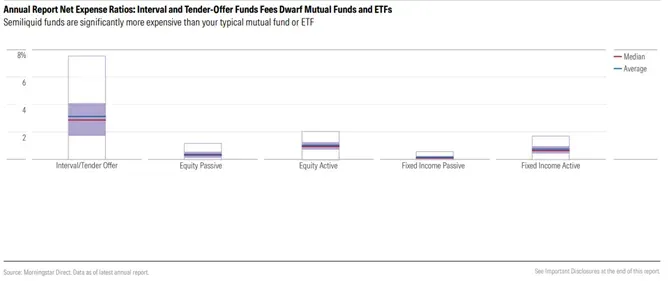
One of the key differences between semi-liquid funds and traditional open-end funds lies in the structure of fees and costs to the investor. These funds are significantly more expensive for their holders, owing to multiple layers of fees: base management fees, incentive fees and even additional, structure-specific costs.
Base Management Fee: As with hedge funds and private funds, an annual management fee is typically charged as a percentage of fund assets. In many cases management fees range around ~1%-2% per year. According to the report, the average net expense ratio of interval and tender-offer funds stands at approximately 3.16% of fund assets – 2-3 times what is customary in traditional mutual funds (for comparison: ETFs and index funds charge ~0.37% on average, and actively managed mutual funds ~0.97%). This enormous gap underscores that, to justify an investment in a semi-liquid fund, private market returns must be significantly higher than those of public markets; otherwise the advantages will be eroded by fees.
Incentive fees: This is where the main complexity lies. Many semi-liquid funds – especially in credit and real estate – charge incentive fees equal to a percentage of the profits the fund generates. The incentive fee model typically comprises three components: the incentive fee rate, a hurdle rate (“Hurdle Rate”) and a catch-up mechanism. Another subtle point is that credit funds typically calculate incentive fees separately on current income and on capital gains. The implication: if a fund has lost NAV value but generated substantial interest income, the manager may still be entitled to a bonus on the income component, because the hurdle rate is measured separately on the income return. Thus, for example, a debt fund can record a small write-down on its loans (a capital loss) while simultaneously distributing a high coupon above the hurdle – and the manager will earn an incentive fee on that coupon, even though the total return is negative! The report highlights this paradoxical situation as raising questions about the reasonableness of incentive fees in fixed-income credit. In addition, credit fund managers have direct control over the interest rate on the loans they extend, and with leverage it is fairly easy for them to set an interest rate that clears the hurdle and collect the bonus. Indeed, the data show that most private credit funds lend from the outset at rates above their hurdle, so that in practice incentive fees are almost always charged (hence the question of whether this is really an “incentive fee” if it is all but guaranteed).
Additional costs: Beyond the ongoing management fee and the incentive fee, an investor in a semi-liquid fund must take into account ancillary costs that can offset returns: sales or distribution charges (where applicable, in funds marketed through advisors or intermediaries, similar to distribution fees in mutual funds), leverage costs (interest on the borrowings the fund takes on – see the discussion of leverage below), and Acquired Fund Fees – where a semi-liquid fund invests in other funds (for example, private investment funds in its portfolio), the management fees of those underlying funds are passed through to the investor as an additional cost. According to the report, in some funds the cumulative fees can reach levels similar to, or even higher than, the management fees themselves, so it is important to examine the full Net Expense Ratio and not only the published base management fee.
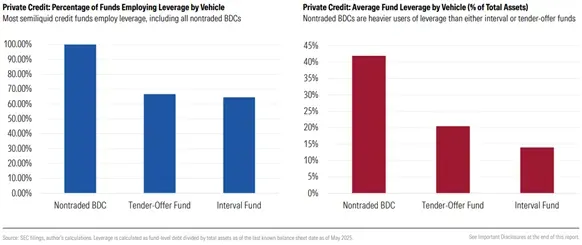
The use of leverage is very common in semi-liquid funds and is a double-edged sword: on the one hand it contributes to performance in normal times, and on the other it can amplify hidden losses and become a burden in times of crisis.
As noted, funds with different structures are subject to different regulatory limits on leverage: interval and tender-offer funds governed by the US Investment Company Act of 1940 (1940 Act) are limited to a debt-to-assets ratio of 1:2 (i.e., debt of up to 33% of total assets). BDCs, by contrast, enjoy a ceiling twice as high – a 2:1 debt-to-equity ratio (debt of up to 67% of assets) – following regulatory relief granted in 2018. Private REITs, as noted, are not limited by law to a specific ratio, but usually follow a more conservative policy (up to ~50%–60% debt). In practice, according to the report, semi-liquid funds do make substantial use of leverage, particularly in the credit and real estate sectors. Fund managers harness bank loans, credit facilities and other debt instruments to expand the fund’s asset base and thereby increase its return potential.
The incentive is clear: leverage raises the target return as long as the cost of debt is lower than the return on the assets. In private credit funds, which may charge borrowers interest of 8%-12%, taking on a loan at 5%-6% can add several percentage points to the return for fund unitholders. It is not surprising, then, that thanks to leverage, semi-liquid credit funds have outperformed their public-market counterparts in recent years. The report notes that the performance of the private funds (the largest among them) exceeded what could have been obtained by investing in a public leveraged loan index – but stresses in the same breath that these public indices do not use leverage, so the comparison is not “neutral” in terms of risk. Leverage magnifies both returns and losses: in a positive period it inflates returns upward, but in a period of defaults and losses it will deepen the damage to the fund’s value.
A further risk lies in the combination of leverage with infrequent valuation: because a substantial portion of semi-liquid fund assets do not trade daily, their NAV is updated only occasionally (quarterly or semi-annually, depending on the asset). This can create an illusion of stability and strong performance – while in reality, risk is accumulating beneath the surface. As the report notes, leverage can “conceal” risks: a leveraged fund that shows a stable value in a given quarter may in fact be significantly exposed to an as-yet-unrealized decline in value. When an extreme event occurs (for example, a sharp rise in loan delinquencies or a drop in real estate values), the fund may suffer both the loss on the asset and distress because of its debt. If its liquidity is limited, it may be forced to restrict redemptions or sell assets hastily (a “fire sale”) to repay debt – a step that harms all investors.
Bottom line: leverage is a key factor in understanding the performance and risks of semi-liquid funds. It explains why credit funds have generated attractive returns over the past decade (leverage + high interest rates), but it is also the reason an investor must carefully examine what lies beneath the hood – to make sure returns are not being “dressed up” in an unsustainable way and that appropriate risk management mechanisms are in place.
What to consider in an investment decision? In-depth analysis of management and incentive fees: Examine the fund’s total weighted net expense ratio, including expected bonuses, and understand how it will affect the net return. In particular, examine the incentive fee mechanism – whether the hurdle is realistic (or absurdly low), whether there is a full catch-up (in most funds, yes), and whether the fund already shows a tendency to clear the hurdle easily (if, for example, the current yield on the assets already exceeds the hurdle, the incentive fee is all but certain). Comparing several competing funds may reveal differences: some funds charge incentive fees on the income component only, others on capital gains as well, and some charge no incentive fee at all – a conscious choice of a fund with or without such a component will have a major impact on the investor’s return.
Leverage levels and asset quality: The investor should understand how much leverage the fund actually plans to deploy (not just the maximum permitted). Higher leverage = higher risk, period. If one fund uses, say, 50% debt and another only 10%, that is a material distinction. The cost of leverage – the interest on the borrowings – should be examined relative to the expected gross return on the assets, to ensure that leverage is “working” in the investor’s favor rather than eroding profits. Asset portfolio quality also matters: for example, in a credit fund – what are the ratings of the loans? What share of loans is high-yield (and correspondingly higher risk)? In a real estate fund – what types of assets (downtown offices versus suburban apartments, etc.) and how are they affected by the economic cycle? Leverage will magnify any error in credit risk management, so reviewing the quality and diversity of the assets is essential.
Liquidity and redemption mechanisms: It is important to fully understand the fund’s liquidity rules: how often can you redeem (quarterly? monthly?), what is the maximum percentage of the fund per window? Is management permitted to defer or reduce redemptions? What has happened in the past – has the fund ever restricted redemptions? An investment in a semi-liquid fund should be regarded as a long-term investment, and the investor should plan realistic exit scenarios – they may not be able to exit immediately when they wish, but only partially and subject to possible exit fees.
Transparency and reporting: Examine the fund’s level of reporting: the frequency of NAV calculation, the detail of holdings, and reporting on signs of distress (such as the share of delinquent loans in a credit fund). Good funds will provide extensive disclosure to earn trust – for example, a breakdown of loans by sector, LTV ratios in real estate, etc. A high level of transparency gives the investor confidence and enables risk monitoring. Promises of smooth, risk-free returns should be taken with a grain of salt – make sure you understand how that smoothness is achieved (whether because of asset quality or because of a lack of up-to-date valuations).
In conclusion, semi-liquid funds are an advanced and sophisticated instrument that has entered the arena over the past decade and offers a unique combination of advantages and disadvantages. They open the door to alternative investments for a wider range of investors and allow diversification beyond public markets, with tempting returns supported by leverage. On the other hand, they demand that the investor have deep understanding, patience and tolerance for less visible risk. A qualified or institutional investor considering this step must “do their homework”: read the prospectus, understand the fee structure, examine the fund managers and their experience, and be sure that the investment suits their horizon and liquidity needs. When used judiciously, these funds can fit as part of the alternative investment sleeve of a portfolio – bridging the gap between public and private, and striking a balance between access to investments that were once exclusive and the management complexity and attendant risks. As the report concludes: the expansion into private markets is well under way, but it does not come free – investors should expect to pay a “price premium” and navigate the new economic environment with care. Only in this way can they reap the potential rewards responsibly and judiciously.
Disclaimer:
Nothing in this publication constitutes an offer to the public or an invitation to make any investment; it is a publication and presentation of general information only. The article and its contents rely on information, publications and data received from third parties, which were assumed to be accurate without the company having examined or verified their accuracy. The information presented in this publication does not constitute investment advice/marketing or a substitute for investment advice/marketing tailored personally and specifically to each individual, taking into account their data, needs, financial situation, circumstances and investment objectives.
Sources:
Morningstar, Inc. (2025). The State of Semiliquid Funds: Credit Is King. Morningstar Manager Research. Retrieved from https://www.morningstar.com