
How to Convert a Private Fund's Net IRR into the Total Return Terms of a Traded Product

Closed-end private funds, such as private equity funds, report their performance using several metrics, the most common of which – and the one that draws the most attention from private investors – is net IRR. When a private investor looks at an annual net IRR, for example in the track record of a manager’s prior funds, they immediately, and not necessarily consciously, compare it to the total return figures they are familiar with from traded investment products. Such a comparison is flawed, because these are different measurement methods and, no less important, products with different characteristics.
Is there any way at all to convert the net IRR of a closed-end private fund into the total return terms of a traded product? And if so, can a calculator be built that is useful for the LP, allowing them to perform the conversion themselves – whether for the historical return of a private fund or for the target return of a fund that is currently fundraising?
To build such a conversion formula, one needs to identify, define and quantify each of the constraints, or uncertainties, that exist when investing in a closed-end private fund but do not exist in a continuously traded investment product. For each of these, the LP is “entitled” to a premium, which raises the return required from the private fund relative to a traded product. The professional discourse on this topic focuses exclusively on the liquidity factor, which is indeed a key driver of the gap. In my view, however, there are five such factors, not just one as is commonly believed:
a) Illiquidity – the product is not traded.
b) The timing of capital calls is set by the fund, not by the LP.
c) The timing of distributions is set by the fund, not by the LP.
d) There is uncertainty about the total amount of capital that will be called out of the LP’s total commitment to the fund.
e) There is uncertainty about whether extension periods beyond the original term will be used.
Each of these factors can be estimated quantitatively and incorporated into the formula (see below for a detailed explanation of how each factor is estimated). For convenience and ease of use, the formula has been built in an Excel spreadsheet as a calculator, which can be used to perform the conversion both for the historical returns of funds that have already been fully realized and for the target returns published by new funds that are in the fundraising stage.
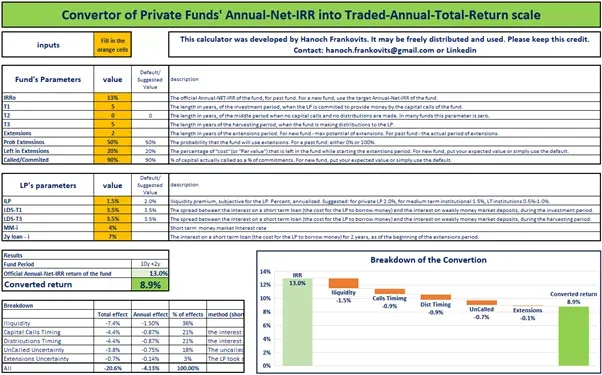
Consider, for example, an LP with fairly average characteristics and a “standard” fund with an Annual-Net-IRR of 13% and a term of 10 years + possible extensions of two years, where the commitment period (capital calls) is 5 years and the distribution period is also 5 years.
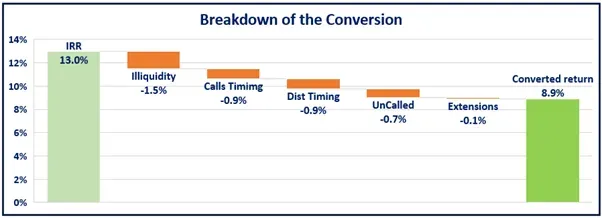
The resulting gap is 4.1% in annual terms; that is, an Annual-Net-IRR-Return of 13% is effectively equivalent to 8.9% in Traded-Annual-Total-Return terms. Broken down by factor, the liquidity constraint accounts for 36% of the gap, the length of the capital call period and of the distribution period for 42% of the gap (21% each), uncertainty about the total amount of capital calls for 18% of the gap, and uncertainty about extension periods for 3% of the gap.
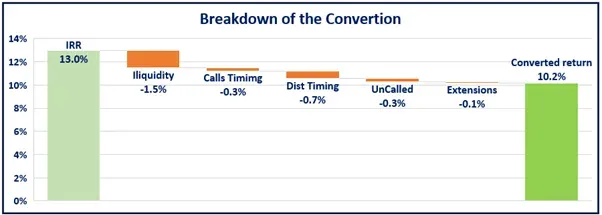
If we look at an otherwise identical fund (13%, 10+2), except that the commitment period is only two years of the fund’s life, we see that the adjusted return rises from 8.9% to 10.2%. This illustrates the significance of liquidity management, and the uncertainty it entails on the LP’s side, during the capital call period.
Can the gap produced by the calculator be used to estimate the gap between a manager’s closed-end funds and its evergreen fund?
The gap produced by the calculator should be slightly higher than the gap we would observe over time between the annual net IRR of closed-end investment funds and the annual total return of the same manager’s parallel evergreen product – provided they invest in the same assets, at the same level of leverage, etc. The reason the gap is not exactly the same is that evergreen products may also restrict withdrawals from the fund during periods of stress. In other words, they are not fully liquid. Thus, items b–e are indeed not relevant to an evergreen fund, but the illiquidity premium should still be partially taken into account.
Appendix – How the premiums are calculated for the 5 items:
From the LP’s perspective, investing in a closed-end private fund entails a number of constraints or uncertainties that do not exist when investing in a traded product. For each of them, the LP is “entitled” to a premium, which raises the return required from the private fund.
a) The illiquidity premium (better known to the public by its charming but inaccurate name: the “liquidity premium”). That is, from the LP’s perspective – what excess return does it require from the illiquid investment compared with an identical investment that is liquid, given that it is giving up the ability to withdraw its money over the investment period.
Each LP should set this premium for itself, subjectively. For example, a pension fund that invests a tiny fraction of its assets in a fund closed for 8 years, and knows the money will only be needed in 30 years, can “require” a very small illiquidity premium, because giving up liquidity is not material from its standpoint. By contrast, a private investor who, under certain scenarios, would very much want to withdraw the money in the middle of the fund’s investment period may “require” a high illiquidity premium.
A number of academic and financial studies have estimated this premium across various asset classes, with the empirical findings in most of these studies falling in the range of roughly 1%-3% per year.
Since we are looking for a standard and simple solution, we will set the illiquidity premium as follows:
For an average private investor – 2.0%
For a medium-term institutional investor – 1.5%
For a pension fund 0.5%-1.0%
Are these numbers actually correct? Note that you do not have to use these constants. Each LP can decide for themselves what liquidity premium they “require” and enter it into the calculator.
The following four components, to the best of my knowledge, have not been addressed at all in the academic literature, nor in the financial/empirical literature on private funds. These components are not negligible and have a real impact on the LP. There is more than one conceivable way to quantify these premiums, so the details below are in effect a proposal, serving as a basis for a more refined solution in the future.
b+c) Capital Calls Timing Premium, (c) Distributions Timing Premium:
This essentially reflects the fact that the LP gives up control over the timing of its investments and over the timing of the proceeds from those investments, since capital calls and distributions are managed and timed by the fund manager. For example, the LP might have preferred to transfer $200 thousand to the fund on February 13, but the fund, as it happens, called $135 thousand on April 22. In other words, there is inconvenience here, and additional uncertainty from the LP’s perspective, regarding the timing of calls and distributions – over and above the liquidity issue itself. The LP’s needs may differ from the fund’s schedule. For this, the LP is “entitled” to an additional premium.
To quantify this premium for the formula, we randomly draw, from a uniform distribution, a single desired date for transferring the money within the commitment period (this is a conservative assumption), and assume that the fund calls capital continuously and evenly over the entire commitment period (i.e., it calls a fraction of the money every day – this is a lenient assumption). When call dates occur before the desired date, the LP will take out loans to cover the timing gap. When call dates are later than the desired date, the LP will place the money in short-term risk-free deposits. In expectation, this premium equals the spread between the interest rate on the loan taken by the LP and the interest rate on the deposit placed by the LP, over a quarter of the fund’s investment period. The same result is obtained for the fund’s harvest period with respect to distributions. That is, the required premium is the spread between the borrowing rate and the deposit rate, over a quarter of the harvest period.
d) Uncalled Commitment Uncertainty Premium:
Private funds usually do not call 100% of commitments. If the fund calls less than the total commitment, then money the LP had planned to put into the fund could already have been invested in an alternative investment. This is an additional uncertainty for the LP, for which it is likewise “entitled” to a premium. The premium is calculated based on the amount actually left uncalled (for past funds) or the amount expected to remain uncalled (for a fund in the fundraising stage; note that the mere fact that the fund will probably call only 80% does not really help the LP, since it must be prepared for the 100% case as well). The cost to the LP is the expected alternative return it could have earned on the amount that was ultimately not called, in an investment of similar risk to the fund (for this purpose, the fund’s target return can be used) over the commitment period – net of the interest it did earn on the uncalled amount in a short-term deposit during the commitment period.
e) Extension option uncertainty premium:Uncertainty as to whether one or more extension periods will or will not be exercised (for example, a fund closed for 8 years with an option to extend by one year and then by another year) is an additional uncertainty for the LP. If there is an extension, the LP does not receive the proceeds on the planned date and must take out a bridge loan for half of the extension period, where the loan amount is only the remainder of the fund that is actually in extension (on a cost basis).
Disclaimer:
Nothing in this publication constitutes an offer to the public or an invitation to make any investment; it is a publication and presentation of general information only. The article and its contents rely on information, publications and data received from third parties, which were assumed to be accurate without the Company having reviewed or verified their accuracy. The information presented in this publication does not constitute investment advice/marketing or a substitute for investment advice/marketing tailored personally and specifically to each individual, taking into account their particulars, needs, financial situation, circumstances and investment objectives.